
Innovation snapshot
| Related REMEDIES pillar | Prevention of plastic waste; zero-waste solutions; circular alternatives to single-use plastics. |
| Partner / owner | Antoine Boudin, self-employed designer and maker. |
| Location | Hyères, Porquerolles, Port-Cros, Le Levant, Le Frioul, France. |
| Made for | Island shops, restaurants, ice cream shops, cold drink bars, visitor-serving businesses, local authorities, protected area managers and organisations seeking practical alternatives to single-use plastic utensils. |
| Technology maturity | A field-tested circular solution implemented in island territories through the “Zero Plastic on the Hyères Islands” campaign and later extended to the Frioul islands. |
| Commercial relevance | A locally produced, washable and reusable alternative to disposable plastic items used in food and beverage services, especially in tourism-intensive island contexts. |
Provence Giant Reed Objects offer a practical and place-based alternative to single-use plastic items such as straws, ice cream spoons, stirrers and cutlery kits. The products are made from natural Provence giant reed, using offcuts from the local reed industry that produces high-quality reeds for musical instruments. By transforming this local material stream into washable and reusable food-service items, the initiative connects plastic prevention, circular economy practice and local craftsmanship.
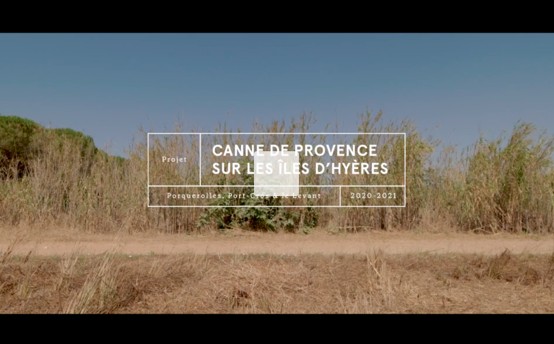
“Canne de Provence sur les îles d’Hyères” project visual
The challenge it addresses
Small islands experience strong seasonal pressure during the summer months, when visitor numbers increase and the consumption of takeaway food, ice cream and cold drinks rises. This leads to higher use of disposable plastic utensils, many of which are used only once before being discarded.
These items often arrive through complex supply chains and can quickly become waste in fragile island environments. In territories such as Porquerolles, Port-Cros, Le Levant and Frioul, the lack of practical local alternatives made it necessary to develop a solution adapted to island businesses, protected natural areas and visitor habits.
- Single-use plastic waste: food and beverage services can generate large quantities of disposable utensils during the tourism season.
- Lack of local alternatives: small island businesses need practical solutions that can be adopted in everyday service settings.
- Pressure on protected island environments: discarded plastic items can end up in nature and coastal ecosystems.
The solution
The solution replaces disposable plastic utensils with objects made from Provence giant reed. The material comes from offcuts generated by the local reed industry, traditionally used to make reeds for wind instruments such as saxophones and oboes.
Antoine Boudin repurposes this material into food-related items such as straws, spoons, forks, knives, ice cream spoons and tapas sticks. The objects are manufactured locally in the Var territory and distributed to participating businesses across the islands.
The approach is rooted in a circular economy model: a natural local material is recovered from an existing production chain, transformed into useful reusable objects and deployed within nearby island communities. This reduces the need for imported disposable plastic items and supports a more local, low-waste service model.
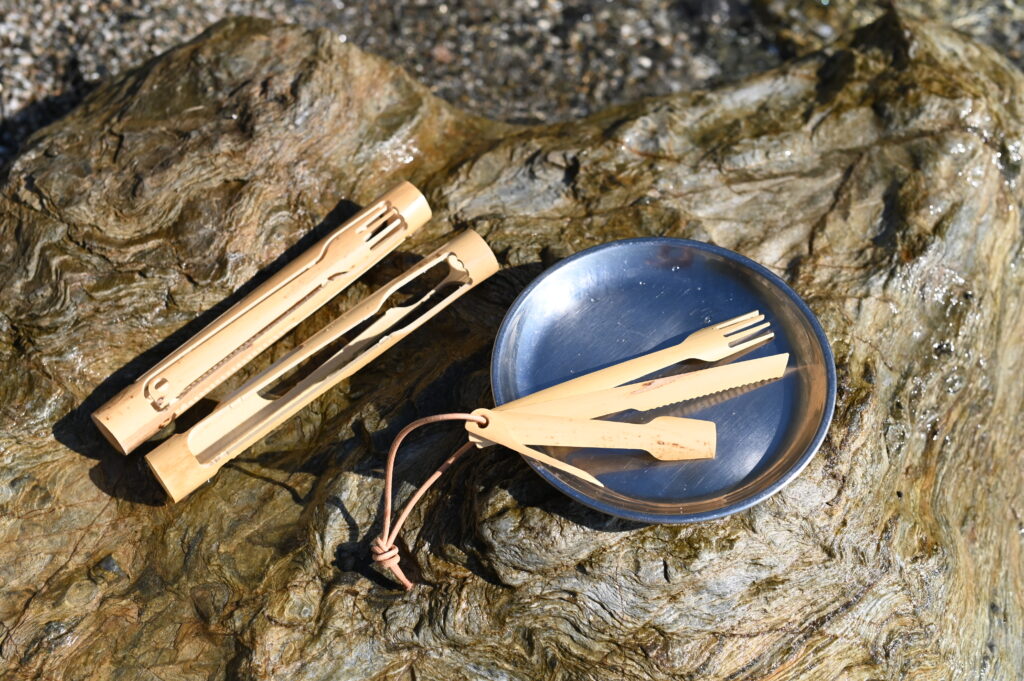
Provence giant reed cutlery set in use context
Unique value proposition
- Local material valorisation: uses Provence giant reed offcuts from the musical reed industry.
- Plastic prevention at source: replaces common disposable food-service items before they become waste.
- Reusable and washable design: offers businesses an alternative to single-use utensils.
- Biodegradable natural material: uses a locally available natural resource instead of fossil-based plastic.
- Short local lifecycle: production and distribution take place locally, strengthening territorial circularity.
- Support for local know-how: connects ecological design with traditional material expertise.
- Island-specific relevance: responds to seasonal tourism pressure and the need for practical alternatives in fragile island settings.
Technical and material characteristics
The objects are crafted from Provence giant reed, a natural material already used in the production of high-quality reeds for musical instruments. Instead of treating reed offcuts as waste, the initiative gives them a second use through eco-designed food-service objects.
The product range includes:
- Straws.
- Cutlery, including spoons, forks and knives.
- Ice cream spoons.
- Tapas sticks.
- Stirrers and related small food-service items.
The objects are designed to be washable and reusable, making them suitable for businesses willing to move away from disposable plastic items. Their value lies not only in the material itself, but also in the local production model, which combines waste prevention, reuse and territorial circular economy practice.
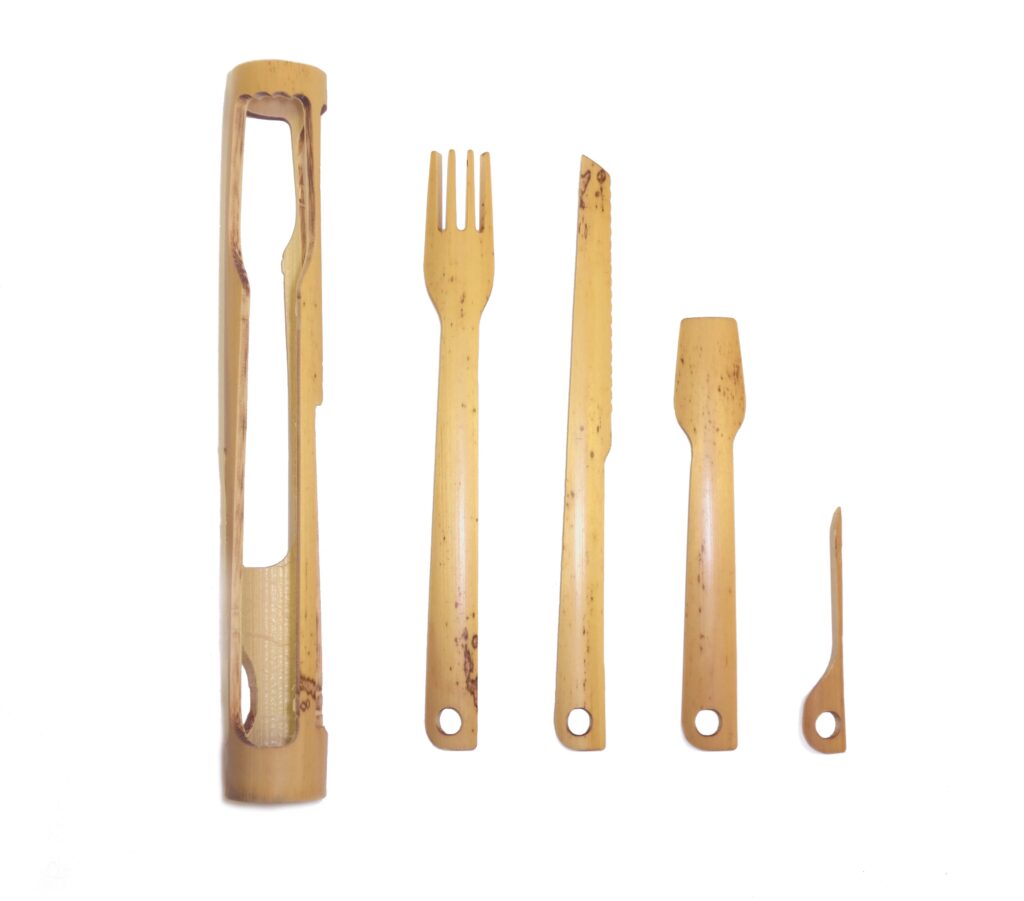
Provence giant reed cutlery set
Field implementation
The initiative was launched through the “Zero Plastic on the Hyères Islands” campaign, beginning in Porquerolles and later extending to Frioul. It was implemented on the islands of Porquerolles, Port-Cros and Le Levant, within Port-Cros National Park, and on Frioul, near Marseille, within Calanques National Park.
Participating island businesses received locally made alternatives to disposable plastic items used in food and beverage services. The model focused on practical adoption by shopkeepers and restaurant owners, showing that plastic prevention can be embedded directly into everyday commercial activity.
The initiative also helped raise awareness among visitors and local businesses by making sustainable alternatives visible at the point of consumption.
Key results
The initiative has demonstrated that local, natural and biodegradable materials can replace single-use plastics in tourism and hospitality contexts. It has supported the valorisation of Provence giant reed waste from the musical reed industry and contributed to the development of a local micro-industry around reusable objects.
It has also helped position the Hyères and Frioul islands as pilot territories for plastic reduction, while increasing public and visitor awareness of available alternatives to disposable plastic items. Businesses adopting the objects have been able to reduce the single-use plastic waste linked to their daily operations.
Who can use it
- Island shops and restaurants: reusable utensils for food and drink services.
- Ice cream shops and cold drink bars: alternatives to disposable spoons, stirrers and straws.
- Municipalities and local authorities: practical tools for local plastic reduction strategies.
- Protected area managers: visitor-facing solutions for reducing waste in sensitive ecosystems.
- Tourism and hospitality actors: visible alternatives aligned with responsible tourism.
- Circular economy initiatives: a replicable example of local material reuse and waste prevention.
- Environmental organisations: a concrete demonstration of behaviour change through product substitution.
Deployment and exploitation pathway
The deployment pathway is based on local production, business adoption and visitor-facing awareness. The model can be replicated in territories where natural material streams, local craftsmanship and pressure from disposable plastics intersect.
- Local material sourcing: identify available natural or biodegradable material streams.
- Eco-design and production: transform local offcuts into practical reusable objects.
- Business engagement: work with shops, restaurants and bars that use disposable food-service items.
- Distribution and adoption: introduce the objects in everyday service settings.
- Awareness and behaviour change: make the alternative visible to customers and visitors.
- Improved uptake models: explore systems such as deposit-return approaches to support reuse and reduce barriers for businesses and consumers.
Main challenges
The main challenge is adoption by businesses, as reusable natural objects can involve a higher upfront cost than disposable alternatives. This can discourage some shopkeepers unless the economic and ecological benefits are clearly communicated. No specific pricing information is included here, in order to keep the marketplace article generic and suitable for public-facing communication.
A deposit-return model could help make the system easier to adopt by encouraging users to return items and supporting businesses in managing reuse. Additional awareness and engagement are also needed to involve more shopkeepers and strengthen understanding of the long-term value of this approach.
Marketplace positioning
Provence Giant Reed Objects are positioned as a locally rooted circular solution for preventing single-use plastic waste in island and tourism settings. The solution is especially relevant for territories where seasonal consumption creates high volumes of disposable food-service items and where local alternatives are needed.
Its marketplace value comes from the combination of natural material use, local production, reuse, biodegradability and cultural know-how. It is not only a product substitution, but a circular model that turns a local by-product into a practical tool for plastic prevention.
Discover more and contact
Designer / maker: Antoine Boudin
Website: https://antoineboudin.com/