
Innovation snapshop
| Related REMEDIES pillar | Prevention of plastic waste; zero-waste solutions; circular alternatives to single-use plastics. |
| Partner / owner | Ahmed Souissi, Association Kraten du Développement Durable de la Culture et du Loisir (AKDDCL) |
| Location | Kerkennah Island, Tunisia. |
| Historical | Craft skills passed down from generation to generation.
Gradual substitution by plastic products over the past decades. |
| Made for | Fishermen and stakeholders in the fishing industry, Island shops, local authorities, protected area managers and organisations seeking practical alternatives to plastic objects. |
| Technology maturity | A field-tested circular solution implemented on Kerkennah island through the organisation of 8 training sessions in 2025 as part of the “No More Plastic in Kerkennah” project, involving around 50 participants (mostly fishermen’s wives). |
| Commercial relevance | A locally produced, natural and reusable alternative to plastic items used in the fishing industry (fishing traps) or in other fields for the other objects that can be done (For instance : basket, vase or placemat in palm tree)
Very useful on an island whose economy depends on fishing and sea resources. |
Challenge adresses
Small islands such as Kerkennah island depend on the fishing industry for their economy. Sea resources are therefore very important. For the moment, fishermen have been using plastic fish traps that pollute a lot of their environment (on land and at sea). This pollution degrades the quality of their natural resources and that’s why changing the fishermen habits could be very productive and profitable for the entire population.
These items often arrive through complex supply chains and can quickly become an important waste problem in fragile island environments.
Kerkennah island hasn’t a lack of practical local alternatives because before the use of plastic the population already used the palm tree as a material in many fields. So it is necessary to reuse and develop this solution adapted to island businesses, protected natural areas and the health of the environment and of humans. Furthermore the visitors will prefer to not see huge pile of trash on their touristic journey.
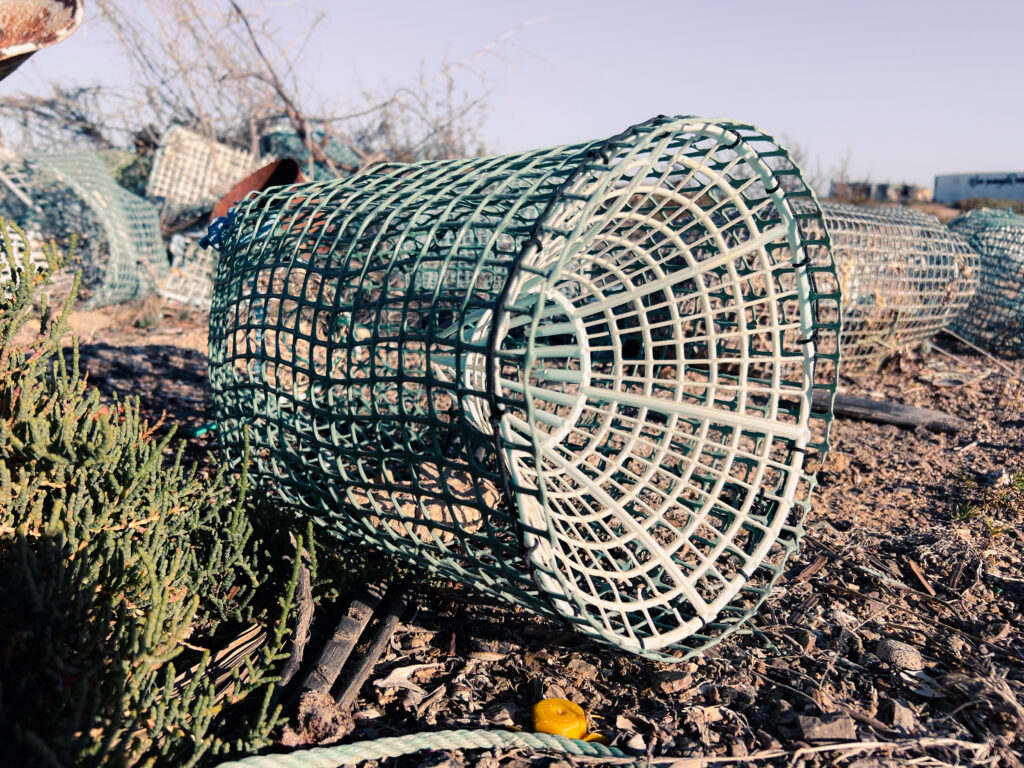
Plastic fish traps left on the coast of Kerkennah island
- Plastic waste: palm tree, a local material, can replace plastic in many uses and in different fields.
- Local alternatives: this alternative is ancestral and perfectly adapted to small island businesses which need practical solutions that can be adopted in everyday service settings.
- Pressure on protected island environments: discarded plastic items can and already end up in nature and coastal ecosystems of Kerkennah island.
The solution
The solution replaces plastic items with objects made from palm trees. It is a revival of an ancestral craft from the island of Kerkennah: the production of functional objects, particularly fishing traps, made from date palm branches.
Once central to the local economy, these traps have gradually been replaced by plastic versions, which contribute to marine pollution and ghost fishing. The initiative reintroduces these biodegradable and locally sourced tools through hands-on workshops.
Ahmed Souissi, from the Association “Kraten du Développement Durable de la Culture et du Loisir” (AKDDCL) based on the island, repurposes this material into different items such as the traps. The objects can be manufactured on the island, the aim is to establish a women’s cooperative dedicated to their production and commercialisation. Then, it could be distributed to participating businesses across the island.
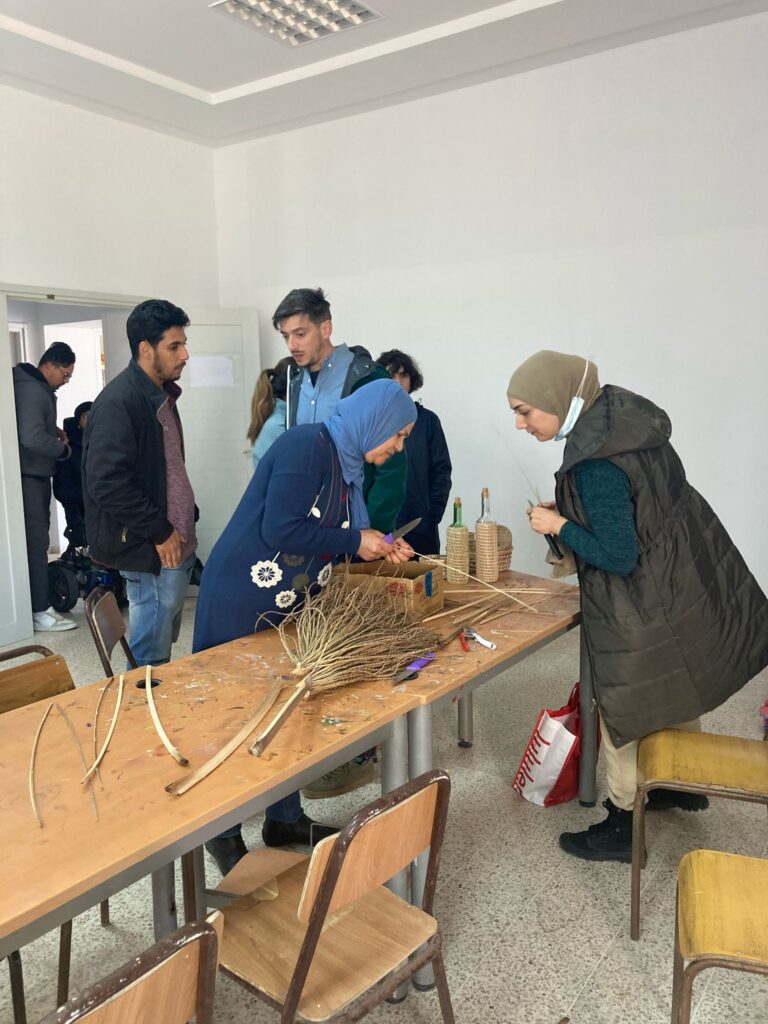
Creation of date palm tree objects by fishermen’s wife on the island during the visit of SMILO
The approach is rooted in a circular economy model: a natural local material is recovered from an existing production chain, transformed into useful reusable objects and deployed within nearby island fishermen communities or others depending on the object. This reduces the need for imported disposable plastic items and supports a more local, low-waste service model.
Unique Value proposition
 Why do we select this solution on the marketplace :
→ It replaces polluting plastic products with biodegradable, locally sourced alternatives.
→ It allows the reduction of marine pollution and ghost fishing caused by plastic traps.
→ It preserves and promotes a traditional craft that is part of the local cultural heritage.
→ It creates new economic opportunities, particularly for fishermen’s wives.
- Local material valorisation: uses palm tree
- Plastic prevention at source: replaces common plastic items before they become waste.
- Natural and reusable design: offers businesses an alternative to polluting plastic objects.
- Biodegradable natural material: uses a locally available natural resource instead of fossil-based plastic.
- Short local lifecycle: production and distribution take place locally, strengthening territorial circularity.
- Support for local know-how: connects ecological design with traditional material expertise.
- Island-specific relevance: responds to fishermen needs and reduces plastic pressure on small islands (need for practical alternatives in fragile island settings.)
Technical and material characteristics
The objects are crafted from palm tree a natural and traditional material, already used in the past. Instead of treating palm offcuts as waste, the initiative gives them a use through eco-designed items. To produce the objects it needed the collection and preparation of date palm branches and then the manual weaving of fishing traps and other items using traditional techniques.
The product range can include :
- fish traps
- basket
- vase
- placemat
- decorative object
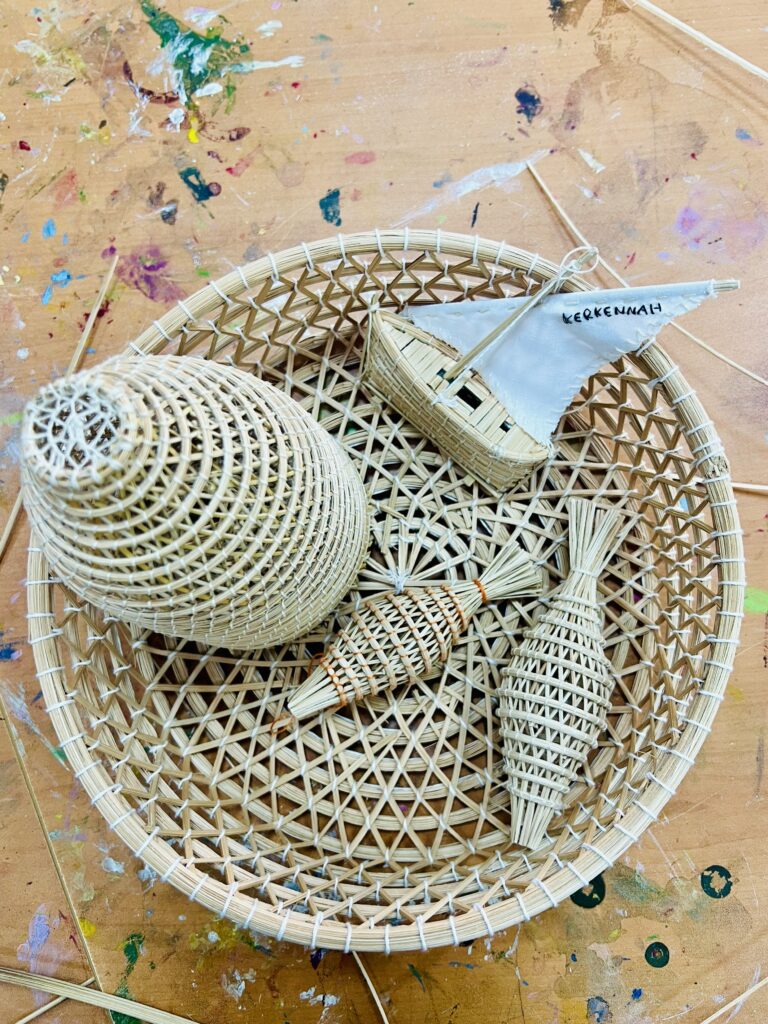
Different objects created by women during a training session
The objects are designed to last overtime, making them suitable for businesses willing to move away from disposable plastic items. Their value lies not only in the material itself, but also in the local production model, which combines waste prevention, reuse and territorial circular economy practice.
Field implementation
The aim was to organize skills-transfer workshops for the local population, with a focus on fishermen’s wives.
The initiative was launched through the “No more plastic in Kerkennah” project, A field-tested circular solution implemented on Kerkennah island through the organisation of 8 training sessions in 2025. The sessions involved 50 participants (mostly fishermen’s wives). We hope that participating island businesses will adopt these alternatives to plastic objects.
The model focused on practical adoption by mostly fishermens, but also shopkeepers and restaurant owners depending on the products, showing that plastic prevention can be embedded directly into everyday commercial and industry activity.
The initiative also helped raise awareness among population and local businesses by making sustainable alternatives visible at the point of consumption. This kind of project can lead to the restoration of marine and coastal areas which are under threat because of plastic pollution.
Key results
The initiative has demonstrated that local, natural and biodegradable materials can replace plastics in fishing industry and tourism contexts. It supports the valorisation of date palm branches and contributed to the development of a local micro-industry around natural and traditional objects.
In three points the results are :
- the resumption of artisanal production of fishing traps and other date palm branch items.
- effective training session with around 50 people formed in 2025.
- the increase of awareness of the environmental benefits of biodegradable products.
Who can use it
- Fishing industry : replacing plastic fish trap by palm tree one’s
- Island shops and restaurants : sale or use of palm tree items (vacation memories for tourists)
- Municipalities and local authorities: practical tools for local plastic reduction strategies.
- Protected area managers: visitor-facing solutions for reducing waste in sensitive ecosystems.
- Tourism and hospitality actors: visible alternatives aligned with responsible tourism.
- Circular economy initiatives: a replicable example of local material reuse and waste prevention.
- Environmental organisations: a concrete demonstration of behaviour change through product substitution.
Deployment and exploitation pathway
The deployment pathway is based on local production, business adoption and population-facing awareness. The model can be replicated in territories where natural material streams, local craftsmanship and pressure from disposable plastics intersect.
- Local material sourcing: identify available natural or biodegradable material streams.
- Eco-design and production: transform local natural material into practical reusable objects.
- Business engagement: work with fishermen’s population, shops and maybe restaurants that use equivalent plastic items.
- Distribution and adoption: introduce the objects in everyday service settings.
- Awareness and behaviour change: make the alternative visible to customers and visitors.
- Improved uptake models: explore systems such as deposit-return approaches to support reuse and reduce barriers for businesses and consumers.
Developing this solution could also help position Kerkennah island as pilot territory for plastic reduction, preservation of environment and depollution. It allows increased public and visitor awareness of available alternatives of plastics objects. So businesses adopting the objects are able to reduce the use of plastic that becomes waste linked to their daily operations.
The next step is to establish a women’s cooperative to produce and sell these items in the Kerkennah and Sfax region.
Main challenges
Main challenges are :
- Competition from cheap, readily available plastic fishing traps.
- Maintaining consistent demand for palm branch products.
- Scaling up production while preserving artisanal quality.
- Ensuring a sustainable supply of palm branches without harming local ecosystems.
The main challenge is adoption by businesses, as reusable natural objects can involve a higher upfront cost than disposable alternatives (in plastic). This can discourage some fishermen or shopkeepers unless the economic and ecological benefits are clearly communicated. No specific pricing information is included here, in order to keep the marketplace article generic and suitable for public-facing communication.
A deposit-return or a repair model could help make the system easier to adopt by encouraging users to return objects and supporting small local businesses in managing reuse. Additional awareness and engagement are also needed to involve more people and strengthen understanding of the long-term value of this approach.
Marketplace positioning
Date palm tree objects are positioned as a locally rooted circular solution for preventing plastic waste in island and fishing industry settings.
The solution is especially relevant for territories where the fishing industry is important, plastic widely spread and where local alternatives are needed.
Its marketplace value comes from the combination of natural material use, local production, duration over time, biodegradability and cultural know-how. It is not only a product substitution, but a circular model that turns a local by-product into a practical tool for plastic prevention.
Discover more and contact
Contact : Ahmed Souissi
E-mail : amcp.kerkennah@gmail.com