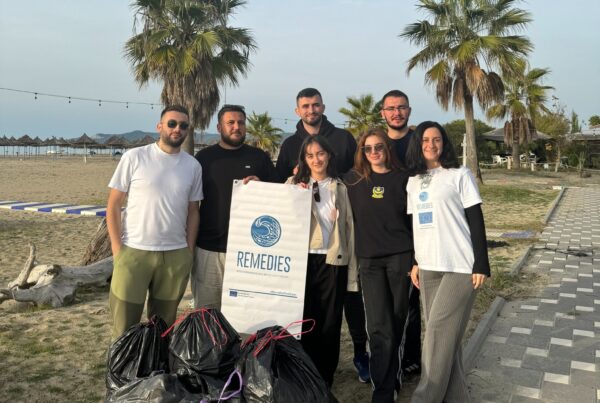

The Underwater Drone Technology represents a cutting-edge solution to detect and monitor marine litter, including both macro and microplastics. The technology combines underwater image-based surveys for large plastic litter items with filtration-based microplastic sampling for subsequent laboratory analysis. It is designed for real-world marine and coastal environments where accurate and repeatable monitoring data are needed .It also detects lost (“ghost”) fishing nets for recovery by divers and streams a live camera feed to the surface, so operators can observe the seabed in real time during each dive.
Watch the related REMEDIES Kope Demo Site video
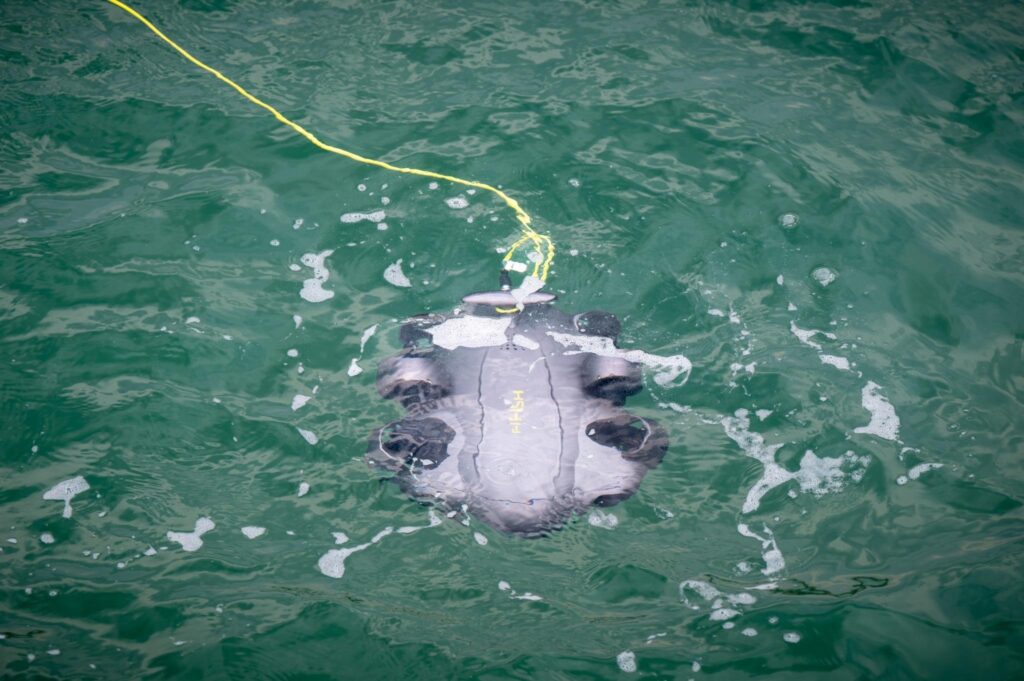 Underwater Drone Technology in field operation
Innovation Snapshot
Innovation: Underwater Drone Technology
Related REMEDIES Pillar: Detection and Monitoring
Partner(s)/Owner(s): Clera.One, in collaboration with Mohammed Premier University, Infordata Sistemi, the National Research Council and Marine Conservation Greece.
Made for: Local and regional authorities, research organizations, NGOs, environmental advocacy groups, industry partners, and educational institutions
Core function: A cutting-edge solution to detect and monitor marine litter, including both macro and microplastics
Technology platform: FIFISH V6 Expert underwater drone with 12 MP camera, custom membrane filtration module, flow meter, water pump and collection tube system; 4K video with dual-LED lighting, six-thruster ROV maneuvering and a mechanical arm for retrieving lost fishing gear
Digital integration: REMEDIES Shoreline ML App, REMEDIES Portal and REMEDIES Impact Dashboard
Validation basis: D1.3, Section 2: Underwater Plastics Detection, plus the REMEDIES Innovation Marketplace pages
Expected readiness pathway: Designed to advance from TRL 5 to TRL 7 by the end of the program in 2026
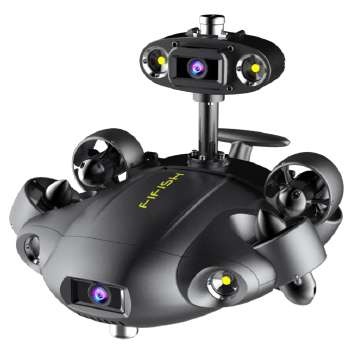 FIFISH V6 Expert underwater drone platform
The Challenge Addressed
Protecting our oceans from plastic pollution requires overcoming challenges in accurately assessing and monitoring marine litter. Traditional methods often provide limited and incomplete data, hindering effective decision-making for cleanup and prevention efforts.
The dynamic nature of marine environments makes it challenging to track long-term trends and understand the effectiveness of interventions. This proves the need for technologies that can provide continuous monitoring and detailed insights into the distribution and movement of marine litter.
- Large underwater plastic litter items need to be detected, marked, labelled and linked to GPS location, photos and videos.
- Microplastics cannot be reliably identified in real time under marine conditions through underwater optical recognition alone.
- Field data needs to be harmonized with monitoring protocols, classification standards and digital reporting workflows.
- Monitoring systems need to support repeatable sampling, targeted clean-up efforts and long-term assessment of marine litter trends.
- ● Lost and abandoned fishing gear (“ghost” nets) is difficult to locate and remove, yet it keeps trapping marine life and shedding plastic for years.
- ● The impact of clean-up actions is hard to prove without comparable before-and-after data on how much litter was present and how much was removed.
The Solution
This Underwater Drone Technology offers a cutting-edge solution for detecting and monitoring marine litter, including macro and microplastics. The drones are launched from ships or seashores to explore various sea depths in the demonstration areas.
For macroplastic detection, the drone uses high-quality underwater imaging and the REMEDIES Portal and App, where large litter items locations are marked and labelled with GPS coordinates, accompanying photos and videos. For microplastics, the drone is equipped with a flow metre, a water pump and a membrane filter to capture samples for laboratory analysis.
In D1.3, Section 2, this filtration-based approach is identified as the validated method for microplastic assessment in REMEDIES, replacing earlier exploratory work on real-time AI-based underwater detection under real marine conditions.
Beyond monitoring, the drone streams a live, screen-mirrored video feed to the surface, letting operators inspect the seabed in real time. It can also locate lost fishing nets and other large items, which are then recovered using the drone’s mechanical arm or by escorting divers. All mission data is relayed through the REMEDIES gateway to the cloud, where surveys taken before and after a clean-up are compared to estimate how much litter has been removed.
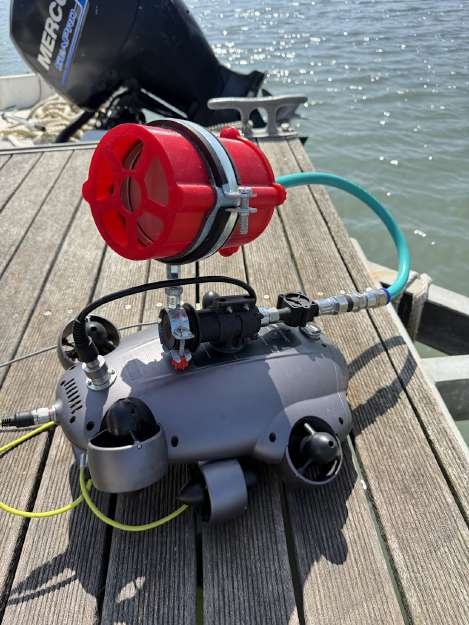 Underwater drone with custom sampling module
How It Works
Macroplastics detection
Macroplastic detection is based on photos and videos collected by the underwater drone, then processed and managed through the REMEDIES digital tools. The underwater AI recognition scope is focused on three clearly distinguishable macroplastic categories: plastic bottles, tires, and fishing nets, plus an unknown macroplastic class.
- The drone captures underwater photos and videos during monitoring missions.
- Spots where photos/videos were taken, are marked with GPS coordinates, depth and accompanying media.
- The REMEDIES Portal processes media files with AI to automatically recognise macroplastic litter items.
- The monitoring data supports automated macroplastics classification and hotspot mapping.
- During the dive, the camera feed is screen-mirrored to the surface in real time, so operators can spot and log large litter items as they appear.
Microplastics sampling and analysis
Microplastic sampling is carried out using a sampling device designed to be used on underwater drones. The objective is to collect microplastics in water in distinct size fractions in a semi-automated way, using a sampling module connected to a collection tube system.
- Deployment from vessel or shore at a predefined location within the demo site.@
- Navigation to sampling depth, maintaining steady position using posture lock and depth lock stabilization.
- Activation of pump and flowmeter to begin seawater intake through the membrane filter.
- Sampling duration typically ranges from 5-10 minutes depending on turbidity and flow rate, with a maximum flow rate of 15-20 L/min to prevent clogging.
- Onboard image capture of the filter before retrieval, to document the presence of visible particles or coloration.
- After the mission, the filter cassette is removed in controlled conditions, the retentate is resuspended in distilled water and stored in glass bottles before being transferred for laboratory analysis.
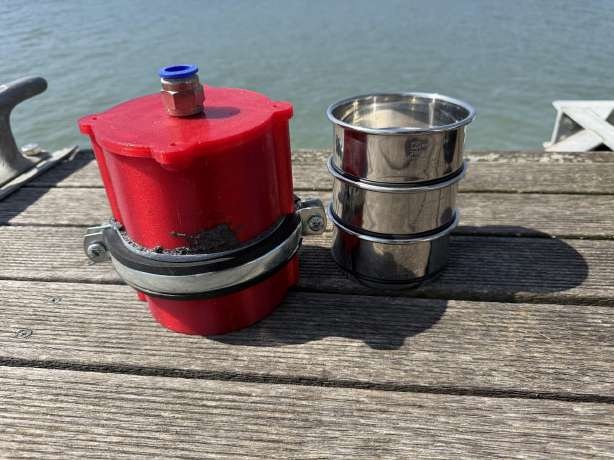 Sampling device, collection tube, designed to be used with underwater drones
Ghost-net recovery and impact tracking
The underwater drone is also used to find and help remove lost fishing nets and other large debris, and to measure the results of clean-up work.
- Detection: large items such as discarded fishing nets are located from the drone’s HD imagery and marked with GPS coordinates, photos and video.
- Recovery: flagged items are removed with the drone’s mechanical arm or by divers guided to the exact location, carried out together with CNR and Marine Conservation Greece.
- Impact tracking: data is sent through the REMEDIES gateway to the cloud, where the same area is surveyed before and after clean-up to estimate the quantity of litter removed.
Technical Features
| Feature | Description |
| Operational depth range | 5-100 meters, optimized for Mediterranean coastal monitoring |
| Camera system | 12 MP Sony CMOS sensor, 4K video capability and underwater imaging for macroplastic detection; dual 3000-lumen LED lighting and 3-axis gimbal stabilisation |
| Microplastic sampling module | Flow metre, water pump, membrane filter and collection tube system |
| Filtration approach | Multi-stage filtration with 300 µm, 100 µm and 50 µm mesh sizes (retention ~99 % / 98 % / 95 %), capturing microplastics in <300, <100 and <50 µm fractions |
| Positioning and stability | Posture Lock and Depth Lock functions support consistent intake conditions during sampling; positioning accuracy ±0.5 m horizontal / ±0.2 m vertical, holding station in currents up to 1.5 knots |
| Digital data capture | Mission metadata, images and lab results are uploaded to the REMEDIES Portal |
| Classification scope | Plastic bottles, tires, fishing nets and unknown macroplastic class for underwater AI recognition |
| Laboratory validation | Optical microscopy, FTIR spectroscopy and SEM used for analysis of collected samples |
| Mission endurance | Up to 8 hours per deployment through power-management optimisation |
| Tether and data | 100 m neutrally buoyant fibre-optic tether; 128 GB onboard storage with automatic cloud backup |
| Live monitoring | Real-time screen mirroring of the camera feed to the surface operator |
| Item recovery | Mechanical arm and diver-assisted retrieval of ghost fishing gear and large debris |
Unique Value Proposition
- Comprehensive detection: The technology addresses both macro and microplastic pollution, offering a holistic approach to marine litter monitoring.
- Repeatable sampling: Filters of varying pore sizes enable comparable microplastic sampling and improve data reliability across different locations.
- AI-supported monitoring: AI algorithms support automated macroplastic recognition and reduce time and effort required for data processing.
- Scalable implementation: The drones’ modular design and advanced capabilities support adaptation for diverse environments and stakeholders.
- Evidence for decision-making: Geo-referenced data of pollution spots can inform policy decisions, resource allocation, environmental protection initiatives and targeted clean-up efforts.
- Ghost-gear recovery: the drone locates lost fishing nets and large debris and supports their removal by mechanical arm or divers, tackling a persistent and harmful source of marine plastic.
- Real-time observation: live screen mirroring lets operators inspect the seabed during the dive, improving detection and mission control.
- Measurable impact: before-and-after surveys relayed to the REMEDIES Portal could quantify how much litter has been removed, turning clean-ups into verifiable results.
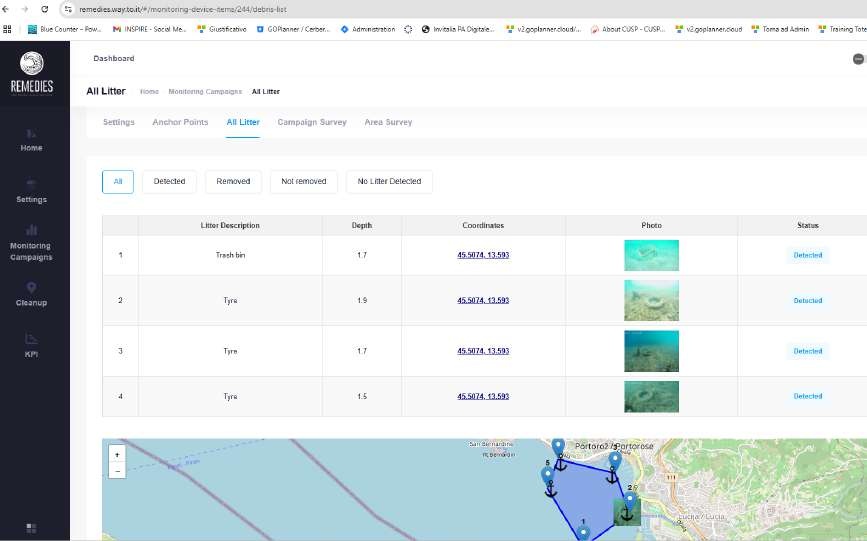 REMEDIES Portal, underwater monitoring list of detected litter
Validation and Demonstration
D1.3, Section 2 sets out validation protocols for the underwater drone system and its integrated microplastic sampling device. These include pre-deployment calibration, replicated sampling and controls, laboratory cross-validation, efficiency metrics, geolocation, operational validation, data quality and FAIR compliance.
- Flowmeters and pumps are tested and calibrated prior to field deployment.
- Membrane filters are validated for retention efficiency and compatibility with the sampling module.
- For each microplastic sampling mission, at least three replicates are collected.
- Control samples are processed to assess contamination risks during handling and filtering.
- Samples collected via drones are analyzed using optical microscopy, FTIR spectroscopy and SEM.
- Deployment coordinates, sampling depths and mission metadata are captured using the REMEDIES App and verified via the Portal.
Across the demonstration sites, more than 25 underwater missions were completed between March and November 2024, with an 87 % mission-success rate. At the Koper demo site (Slovenia) about 16.2 km² of seafloor was surveyed, and at the Sinis Peninsula (Sardinia, Italy) drone sampling was cross-validated against traditional MANTA-net sampling over a further 2.8 km². Laboratory analysis at CNR confirmed PET microplastic recovery rates of 32–64 % using optical microscopy, FTIR spectroscopy and SEM.
The technology has been tested at REMEDIES Koper Demo Site in Slovenia and the Sinis Peninsula (Sardinia, Italy) and is tailored to meet the unique challenges of coastal and marine environments.
Who Can Benefit
| User group | How they can use it |
| Local and regional authorities | Monitor and manage marine litter in coastal regions and support data-driven clean-up planning. |
| Research organizations | Collect precise data to strengthen studies on marine ecosystems, microplastics and pollution trends. |
| NGOs and environmental advocacy groups | Use accurate insights into litter hotspots to strengthen campaigns and targeted interventions. |
| Industry partners | Identify areas for waste reduction and sustainability improvements. |
| Educational institutions | Use the technology in training and awareness programs on marine litter monitoring and ocean protection. |
Deployment and Exploitation Pathway
The underwater drone technology’s exploitation pathway includes strategic partnerships and commercialization efforts to maximize its impact.
- Collaborative Research Projects: Joint R&D initiatives with stakeholders to further enhance the technology’s capabilities and adapt it to specific needs.
- Commercialization: Offering the solution as a product and software subscription to local authorities, research institutions, and environmental organizations.
- Capacity Building: Training programs and workshops for stakeholders to ensure effective deployment and operation of the technology.
- Scalable Implementation: Expanding its use to additional regions and applications, supported by ongoing advancements in AI and monitoring capabilities.
Discover More
Clera.One: https://www.clera.one/
Contact for further information: info@remedies.com