
Innovation snapshot
H2Oasis is a portable atmospheric water generation solution designed to address two linked challenges at the same time: access to drinking water and prevention of single-use plastic bottle waste. The system produces, purifies, stores and dispenses potable water from ambient air, supporting refill and reuse models in locations where bottled water distribution is costly, logistically difficult or environmentally harmful.
Related REMEDIES pillars: Prevention and Zero-Waste Solutions; Water Refilling Technologies; Circular Reuse Models
Partner(s)/Owner(s): Marine Conservation Greece (MCGREECE), within the REMEDIES project
Made for: Municipalities, remote and island communities, hotels and resorts, companies, households, emergency-response actors, investors and organisations seeking alternatives to bottled water
Technology maturity: REMEDIES materials position the solution as a demonstrator advancing through field deployment and exploitation. The Mykonos deployment validates the AWG in a real beach setting
Commercial relevance: Designed for users that need local drinking water generation while reducing reliance on single-use plastic bottles and water transport logistics
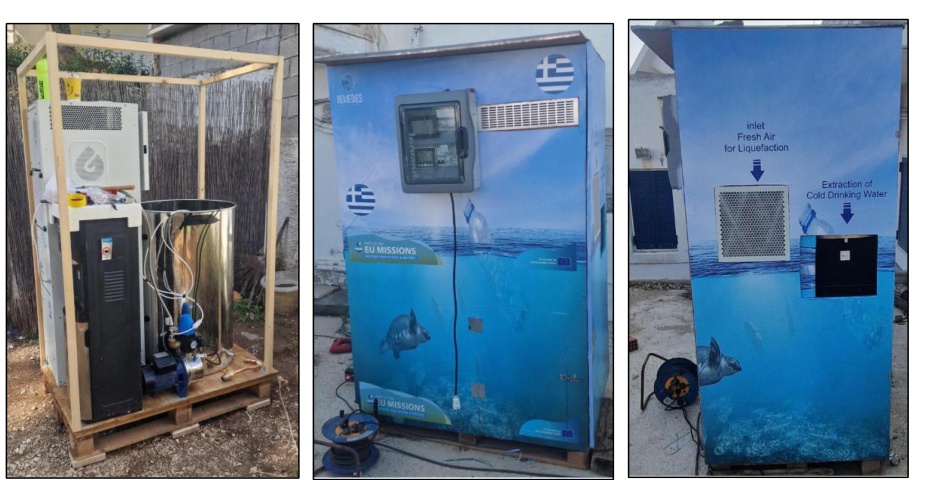 H2Oasis Water Generation System components and complete unit. Source: REMEDIES D3.1
The challenge it addresses
Many coastal and island territories face pressure on water availability, especially during tourist seasons and in locations where water must be transported or supplied through limited infrastructure. These pressures are directly connected with high consumption of bottled water, which increases single-use plastic waste and transport-related impacts.
- Water scarcity and access: islands, remote sites, drought-prone areas and locations without reliable public water networks need local drinking water solutions.
- Plastic pollution prevention: bottled water distribution relies heavily on single-use plastic packaging, especially in tourism, outdoor recreation and public events.
- Transport and energy pressure: moving bottled water by land, air or sea can increase fossil-fuel use, costs and operational complexity.
- Behavioral transition: users need visible and practical alternatives that make refill and reuse easy in everyday settings.
The solution
H2Oasis generates drinking water from atmospheric moisture and combines water production with purification, storage, cooling and dispensing. In the REMEDIES demonstrator, ambient air is drawn into a dehumidifier, where water vapour is condensed and collected. The condensate is then treated through mineral enrichment, activated-carbon filtration and ultraviolet disinfection before being stored and served to users.
The system is designed to work as part of a reuse pathway. In the Mykonos pilot, the AWG was deployed with reusable 0.3L glass bottles, allowing visitors to access drinking water without relying on disposable bottles. This makes H2Oasis both a water access solution and an upstream prevention measure for plastic pollution.
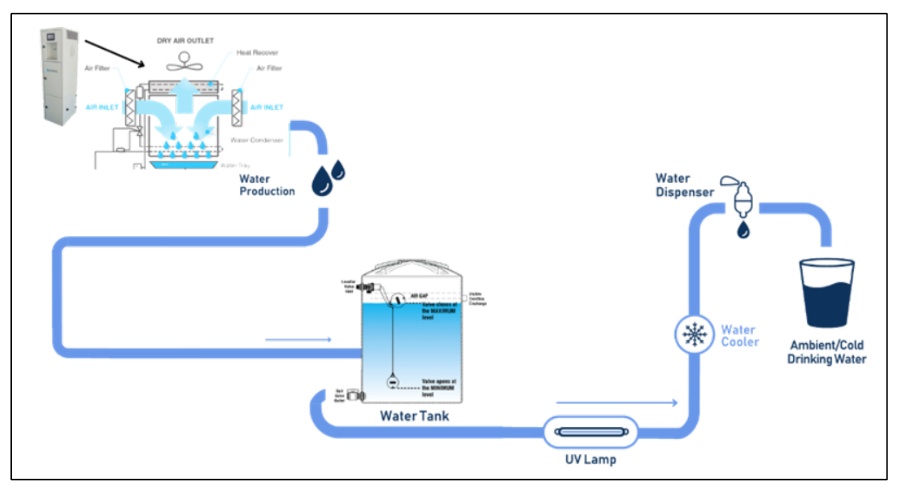 Diagram of the Water Production Process of the AWG, from air capture and water production to tank storage, UV treatment, cooling and dispensing. Source: REMEDIES D3.1
Unique value proposition
- On-site water generation: produces drinking water from ambient humidity, reducing dependence on external bottled water supply chains.
- Reuse-ready service model: works with reusable bottles and refill behaviour, making the alternative visible and practical for users.
- Portable and modular deployment: the complete unit is mounted on a Euro-pallet with standard dimensions of 1.2 x 0.8 m and can be moved with a pallet jack.
- Integrated purification and safety: the system includes mineral enrichment, activated-carbon filtration and UV treatment before delivery to the end user.
- Cold water service: the unit includes cooling capacity, making it suitable for outdoor and high-temperature settings such as beaches and visitor sites.
- Field-tested demonstrator: the system was deployed at Lia beach in Mykonos to serve visitors beyond the organised beach area.
- Plastic pollution prevention: the solution supports a shift away from bottled water and single-use plastic packaging.
Technical characteristics
The REMEDIES D3.1 technical description presents the AWG as a compact unit developed by MCG to produce, purify, store and dispense potable water derived from ambient air. The demonstrator includes a Gennaq s50 dehumidifier, a 150L stainless-steel storage tank, a stainless-steel Flow 100 370W PM5 Plus pump and an Eiger EG103B-F water chiller equipped to deliver cold and hot water on demand.
- Nominal water production in the D3.1 demonstrator: up to 50L of potable water per day, depending on humidity and temperature conditions.
- System weight and transport: slightly over 200 kg, mounted on a standard Euro-pallet footprint of 1.2 x 0.8 m.
- Storage: purified water is stored in a main 150L stainless-steel tank.
- Treatment: mineral enrichment, dual-stage filtration with activated carbon and UV light for microbial decontamination.
- Cooling and delivery: water is pumped from the storage tank to a cooling unit that includes a 2L reservoir for cold water service.
- Monitoring: automated operation through a local control panel displaying dehumidifier status, water volume, storage tank temperature and pump pressure.
- Energy performance in the D3.1 demonstrator: approximately 85 kWh total energy consumption, corresponding to an average specific energy consumption of 0.39 kWh per liter of produced water.
- Water quality: preliminary testing and laboratory analyses conducted by NTUA confirmed compliance with current European drinking water standards.
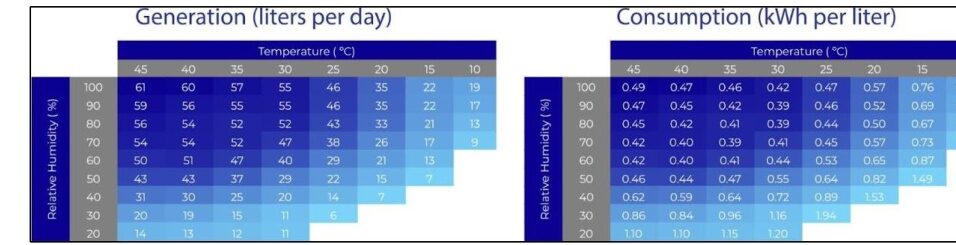 Temperature and humidity impact on water production and energy consumption of the AWG. Source: REMEDIES D3.1
System operation and deployment
The system operation follows a clear sequence: air capture, condensation, water collection, treatment, storage, cooling and dispensing. Ambient air enters the dehumidifier and the condensed water is collected in a stainless-steel tray. The water passes through an internal reservoir and treatment process, including mineralisation, activated carbon and UV light. It is then stored in the 150L tank and pumped to the cooler before reaching the user-facing dispenser.
The D3.1 deployment shows that the AWG can be installed as a public-facing refilling station. Explanatory illustrations on the unit guide users by showing the fresh air inlet, the water extraction point and the simplified flow from air absorption to storage and consumption.
Field validation and capacity building
The AWG demonstrator was deployed at Lia beach, Mykonos, Greece. According to the D3.1 pilot description, it was installed on the opposite side of the beach bar to generate and provide cool water to random visitors, with the objective of expanding reuse practices beyond the organised beach area. By embedding the reuse scheme into the beach experience, the pilot encouraged visitors to adopt sustainable behaviours in a visible and practical way.
The Mykonos deployment also included reusable 0.3L glass bottles. D3.1 notes that a smart use pathway is needed to support effortless returns and ensure a safe and hygienic circular supply chain on site. The reported total capacity of items to distribute and reuse is 5,000 glass bottles.
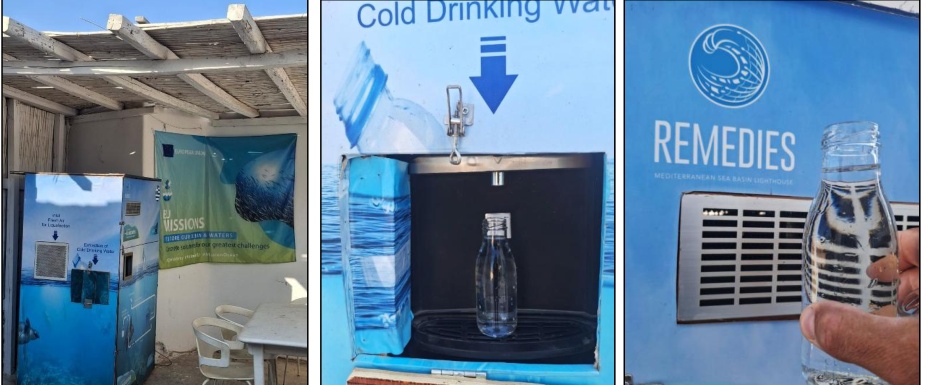 Deployment of the water refilling station (AWG) on Lia beach, Mykonos demo site. Source: REMEDIES D3.1
Who can use it
- Municipalities and public authorities: local drinking water access, public refill infrastructure and emergency preparedness.
- Island and remote communities: reduced dependence on transported bottled water and improved local water resilience.
- Hotels, resorts and beach operators: guest-facing water service that supports environmental strategies and reduces single-use plastic bottle use.
- Companies and organisations: sustainable water provision for offices, campuses, temporary installations and off-grid operations.
- Events and cultural sites: refill services in high-footfall settings where bottled water waste is a recurring challenge.
- Households and off-grid users: reliable drinking water access in locations where conventional water infrastructure is limited.
- Business stakeholders, sponsors and investors: a scalable sustainability solution with a clear exploitation pathway and replication potential.
Deployment and exploitation pathway
The exploitation pathway for H2Oasis combines public-sector deployment, hospitality and corporate adoption, direct sales or leasing and awareness-building around refill and reuse. The D3.1 field deployment strengthens the pathway by showing that the system can operate in a real Mediterranean tourism context and support a practical alternative to single-use bottled water.
- Municipal partnerships: integrate the system into local water access points, coastal public spaces and emergency preparedness plans.
- Tourism and hospitality deployment: support beach bars, hotels and resorts seeking visible alternatives to bottled water.
- Corporate and organisational adoption: provide sustainable water access for companies, campuses and institutions.
- Direct sales and leasing: offer flexible purchase, rental or service models depending on customer capacity and use case.
- Awareness and behavior-change campaigns: use the visible system graphics and refill pathway to encourage users to choose reuse.
- Scaling and replication: prioritise regions facing water scarcity, plastic pollution pressure, high tourism intensity and high bottled-water logistics costs.
Marketplace positioning
H2Oasis is positioned as a practical, portable and scalable water generation system for users that need clean drinking water without expanding plastic packaging or fossil-fuel-based water transportation. Its marketplace relevance is strongest where water access, tourism pressure, climate vulnerability and single-use plastic waste intersect.
The solution can be communicated as an integrated prevention system rather than only a water machine: it generates water locally, treats and cools it for immediate use, supports reusable bottle circulation and helps communities demonstrate tangible alternatives to disposable bottled water.
Discover more and contact
- MCGREECE: https://www.mcgreece.gr
- Contact for further information: info@remedies.com