
Innovation Snapshot
The Microplastic Filtration System Clera.One is an advanced decentralized wastewater treatment technology that addresses critical challenges in microplastic pollution. By capturing microplastics directly at the source, the system prevents them from re-entering natural water bodies.
Designed for on-site applications, Clera.One offers a sustainable, scalable solution for industries aiming to reduce their environmental footprint. The system integrates high-performance filtration and supports circular economy practices through water treatment and reuse pathways.
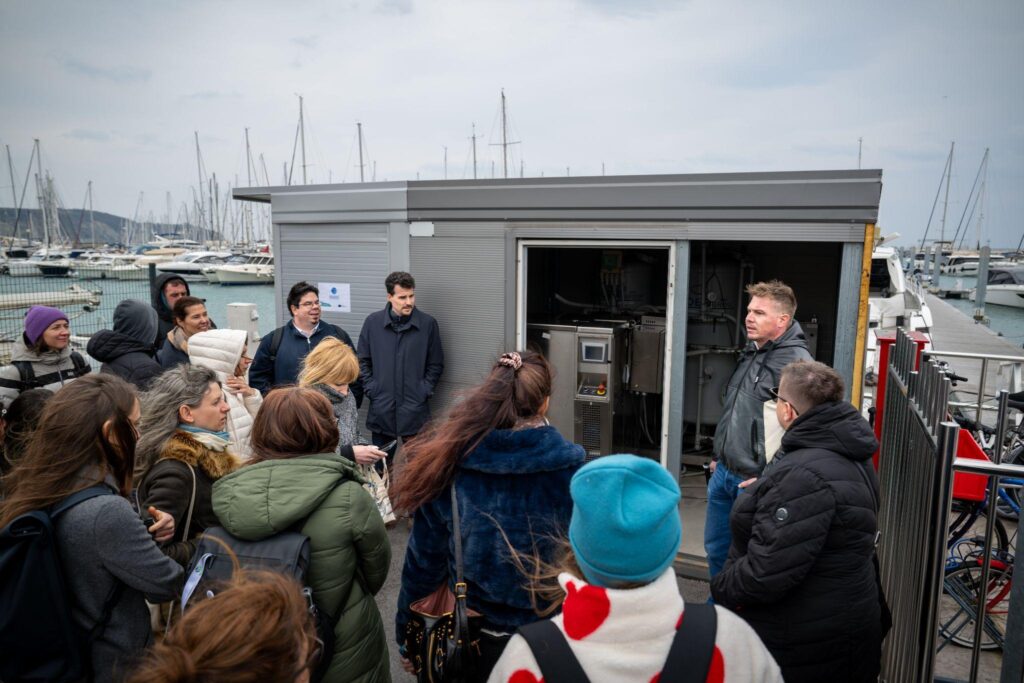
Within REMEDIES, the filtration system is presented as a practical solution for marinas, laundry services, cruise services, industrial wastewater facilities and environmental NGOs. It has been tested at the REMEDIES Koper Demo Site in Slovenia and is connected to the Collection & Valorisation and Prevention & Zero-Waste Solutions pillars.
Related REMEDIES Pillars:
Collection & Valorisation; Prevention & Zero-Waste Solutions
Partner(s)/Owner(s): Clera.One
Made for: Marinas, laundry services, cruise services, industrial wastewater facilities, and environmental NGOs
Core approach: Decentralized, on-site wastewater treatment that captures microplastics at the source and supports water reuse.
Demonstration context used here: Marina Izola, Slovenia, and laundry wastewater treatment, based on REMEDIES D2.1, Sections 2 and 3.
Capacity / scalability: Modular and scalable units. REMEDIES Marketplace page: 1-5 m³/hour. REMEDIES innovation article: 1-50 m³/hour.
Technology Readiness Level: Expected to achieve TRL 8 by the conclusion of the REMEDIES program in 2026.
Watch the related REMEDIES Kope Demo Site video:
The Challenge Addressed
Microplastic pollution and water scarcity are interconnected global challenges. Traditional wastewater treatment systems often lack the capacity to effectively remove microplastics, leading to their release into natural water bodies. Conventional centralized wastewater treatment infrastructure can also require significant energy, water use and transportation infrastructure.
D2.1, Sections 2 and 3, show two practical sources where microplastic trapping and water recycling are needed: marina wastewater from boat washing and laundry wastewater containing synthetic fibres and chemical additives.
- At Marina Izola, wastewater from marina activities contained much more plastic particles than expected, with samples measured at 10,950 MP/L, 27,460 MP/L and 15,090 MP/L, giving a mean value of 17,833 MP/L.
- The marina wastewater also contained other impurities, remains of oils and high quantities of heavy metals, requiring a more complex and sophisticated filtration design.
- In laundry applications, fabric softeners and other chemical additives can compromise membrane performance, making a tailored filtration process necessary.
- For both use cases, the market need is clear: practical, decentralized systems that reduce microplastic discharge and support water reuse where possible.
The Solution
Clera.One’s Microplastic Filtration System is an advanced decentralized treatment technology addressing microplastic pollution. Its modular, scalable units treat wastewater at the source, reducing reliance on extensive piping and transportation and lowering operational complexity for users.
The system captures microplastics before discharge and combines high-performance filtration with real-time monitoring and automated control. According to the REMEDIES Marketplace page, Clera.One’s modular and scalable solutions offer treatment capacity from 1-5 m³/hour. According to the REMEDIES innovation article, the modular design offers customizable treatment options ranging from 1 to 50 m³/hour.
In D2.1, Section 2, the system is applied to marina wastewater treatment. In D2.1, Section 3, the technology is adapted for laundry wastewater through a redesigned four-step process that includes reverse osmosis to support reuse and compliance with water quality requirements.
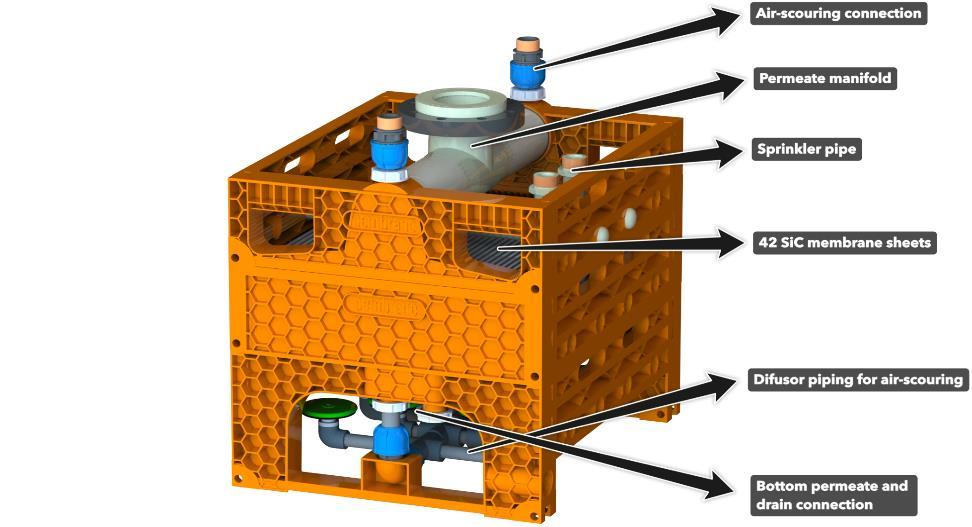 Basic parts of the filtration module with SiC membrane sheets
How It Works:
Marina wastewater treatment
For marina applications, the filtration system is based on a high-performance Silicon Carbide Ceramic Membrane (SiC membrane). The filtration principle is submerged outside-in: clean water is drawn through the membrane with suction pressure, while suspended solids and bacteria are rejected on the membrane surface.
- Wastewater enters the treatment system from the marina collection infrastructure.
- The SiC membrane acts as a barrier to contaminants, including suspended solids, oil, bacteria and algae, and other micropollutants.
- Backwash reverses the flow rate to remove solids build-up from the membrane surface.
- A sprinkler system supports mechanical removal of debris and chemical spray cleaning, reducing chemical consumption compared to conventional CIP.
- An ozonation unit is integrated to reduce toxic pollutants and pathogenic bacteria without leaving toxic residues that must be removed or disposed of.
- Safety and operational valves redirect water when turbidity or system thresholds are exceeded, and a carbon filter with pressure regulation is included at the end of the process.
Laundry wastewater treatment
For laundries, D2.1 shows that the initial development plan had to be adapted because cationic fabric softeners bind to the negatively charged SiC membrane and can block filtration within minutes. The redesigned laundry process uses a four-step filtration process.
- Initial microfiltration through quartz sand separates substances larger than 1 micron, especially suspended solids and insoluble substances.
- Granular active carbon filtration acts as a depuration step.
- Ultrafiltration with hollow fibre micro-capillary membranes separates soluble substances with low molecular weight, including organic molecules, bacteria and some viruses.
- Reverse osmosis and nanofiltration separate residual soluble organic substances and nearly all simple or composite soluble salts. The design objective is to recover 70% of effluent discharged from washing processes, producing technical water suitable for reuse.
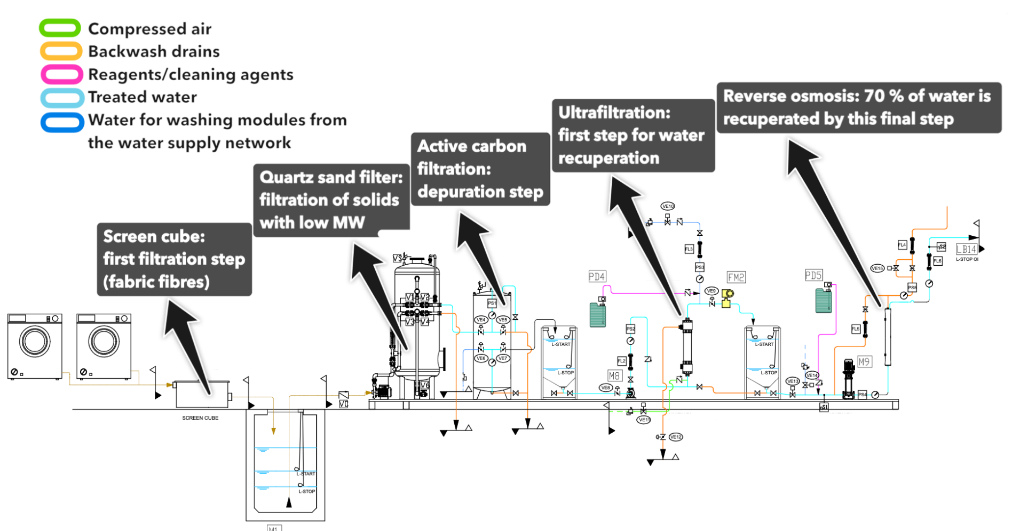 Wastewater filtration process scheme for laundries
Technical Features
| Feature | Description |
| Decentralized treatment | On-site wastewater treatment designed to treat water at the source and reduce dependence on centralized infrastructure. |
| SiC membrane | High flux rate, chemical resistance, reduced fouling, durable material, high solids loading capability and simplified flow sheet. |
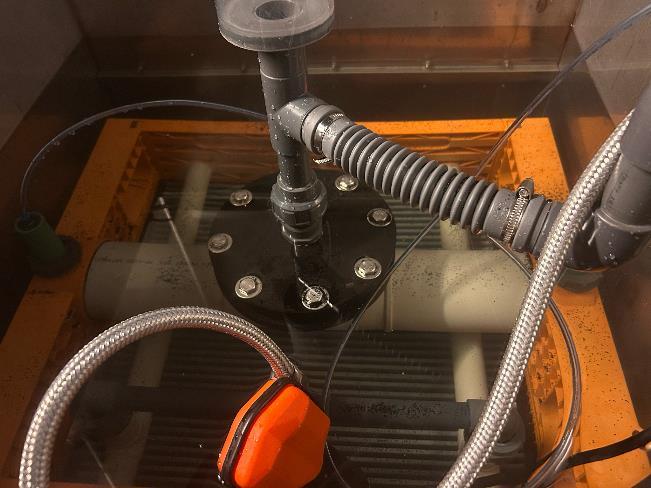
| Modular design | Membrane sheets are fitted in square modules of 42 membrane sheets. Modules are submersible and stackable, supporting scale-up. |
| Ozonation unit | Oxidative treatment step used to reduce toxic pollutants and pathogenic bacteria; oxygen is generated by pressure swing adsorption. |
| Venturi valves | Used to dissolve ozone into water efficiently and reduce ozone off-gassing for a safer operational environment. |
| IoT integration | Sensors support real-time monitoring of water quality parameters such as pH, ORP and conductivity, enabling automated control. |
| Laundry process | Four-step process combining quartz sand filtration, granular active carbon filtration, ultrafiltration, and reverse osmosis / nanofiltration. |
| Water reuse potential | In laundries, the design objective is to recover 70% of washing-process effluent as high-quality technical water for reuse. |
Unique Value Proposition
- Decentralized Efficiency: Treats wastewater directly at the source, reducing infrastructure costs and carbon footprints associated with centralized systems.
- Advanced Filtration: High-performance filtration membranes effectively remove microplastics and improve water quality.
- Scalable Capacity: Modular treatment options support different industrial needs and allow adaptation to specific users.
- IoT Integration: Real-time monitoring and automated control support operational reliability and data-informed management.
- Circular Economy Approach: The system supports water reuse and reduces reliance on external water sources.
- Environmental Impact: By addressing pollution and resource scarcity, the system supports a more sustainable water management paradigm.
Validation and Demonstration
D2.1 reports three pilot implementations for microplastic trapping demonstrators: Marina Izola in Slovenia, a laundry facility demonstrator, and the Mykonos Wastewater Treatment Plant in Greece. This marketplace text focuses on Sections 2 and 3: marina and laundry applications.
- In controlled environments, the microplastic filtration systems demonstrated promising results exceeding 95% microplastic removal efficiency.
- At Marina Izola, the system was designed to make wastewater safe to be discharged into the sewage system, because unpredictable contamination made safe water reuse difficult to guarantee.
- For marina wastewater, the objective remains environmentally important: removing more than 95% of microplastics present in the water would protect the environment before discharge.
- For laundry wastewater, the system was redesigned after testing showed membrane blocking caused by fabric softeners. The final process includes reverse osmosis to support compliance and reuse.
- Long-term monitoring of microplastics in treated water was carried out using fluorescence-based analytical techniques, while Life Cycle Assessments validated the system’s capacity to remove microplastics from wastewater and reduce pollution loads before discharge or reuse.
Who Can Benefit
- Marinas that need to reduce microplastic release from boat washing, maintenance and wastewater streams.
- Laundry services that need to reduce microfiber discharge from synthetic textiles and recover treated water where possible.
- Cruise services and industrial wastewater facilities looking for decentralized wastewater treatment solutions.
- Environmental NGOs and advocacy groups that want to showcase practical solutions for microplastic pollution.
- Municipalities, port authorities and funders interested in scalable, source-based interventions for cleaner waters.
Exploitation Pathway
The exploitation strategy for Clera.One focuses on innovation, partnerships and market expansion. The REMEDIES innovation article identifies collaborative development, commercialization, awareness and training, and scalability as the main pathway for putting the technology into action.
- Collaborative Development: Partnering with environmental organizations and industry stakeholders to enhance system capabilities and tailor solutions.
- Commercialization: Offering the system through service rentals or direct sales to marinas, cruise services and industrial facilities.
- Awareness and Training: Conducting workshops to educate stakeholders on the technology’s applications and benefits.
- Scalability: Expanding deployment across diverse sectors and regions, supported by ongoing advancements in filtration technologies.
Discover More
Clera.One: https://www.clera.one/
Contact: info@remedies.com