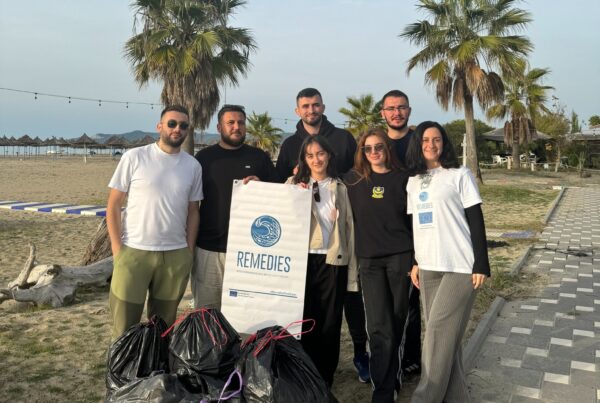

The River Cleaning System is an innovative, semi-permanent solution designed to tackle plastic pollution in rivers. It uses spinning modules to efficiently collect riverine litter while avoiding clogging and stagnation that can deteriorate water quality and break down plastics into microplastics.
The system is autonomous, eco-friendly, modular and adaptable. It requires no external power, integrates with river activities and supports the valorization of collected materials, including recycling pathways and circular economy applications.
Within REMEDIES, the Albanian Demo Site, specifically Lana River which flows through the center of Tirana, was selected to test and demonstrate the River Cleaning System. Due to an interruption in the permitting process, the River Cleaning system was relocated at its testing site, in Roggia Dolfina (Italy).
As part of the innovation development during REMEDIES, the technology specifications, customization process, demonstration setup, operations and value mapping approach were clearly outlined. Details, foreseen activities and results related to the replication demo site in Italy will be incorporated for further exploitation.
Innovation Snapshot
Innovation: River Cleaning System
Related REMEDIES Pillar: Collection and Valorization
Partner(s)/Owner(s): River Cleaning
Other partners involved: University of Maribor – Sustainability Assessment
Made for: Municipalities, water management / river basin authorities, remediation authorities, environmental services companies, marinas, the tourism sector, and packaging manufacturers
Core approach: An innovative, semi-permanent solution designed to tackle plastic pollution in rivers using spinning modules that collect riverine litter.
Demonstration context used here: Custom designed for Lana River, Albania. Relocated and demonstrated in Roggia Dolfina (Italy) due to missing authorization from Albanian authorities (Municipality of Tirana).
Technology Readiness Level: TRL and MRL reached 8 in REMEDIES project in 2026.
The Challenge Addressed
Plastic pollution in rivers contributes significantly to marine debris. The REMEDIES Marketplace page describes river plastic pollution as a major source of marine litter, while the REMEDIES innovation article states that rivers account for approximately 85% of the total plastic litter discharged into seas and oceans each year.
- Traditional river clean-up methods often rely on manual labour and can be limited in reach, efficiency, time scope and scalability.
- Many existing solutions require external power sources or extensive infrastructure, increasing operational costs and environmental impact.
- Conventional approaches may obstruct river activity, demand high maintenance, or create clogging and stagnation risks.
- The challenge is not only to collect litter, but also to support sorting, recycling and valorization so that collected materials can enter circular economy pathways.
The Solution
The River Cleaning System is a non-permanent barrier sustained by an array of floating buoys, linked through a horizontal metal truss. The floating buoys include passive propellers, rotating by virtue of the river stream, without any external power source.
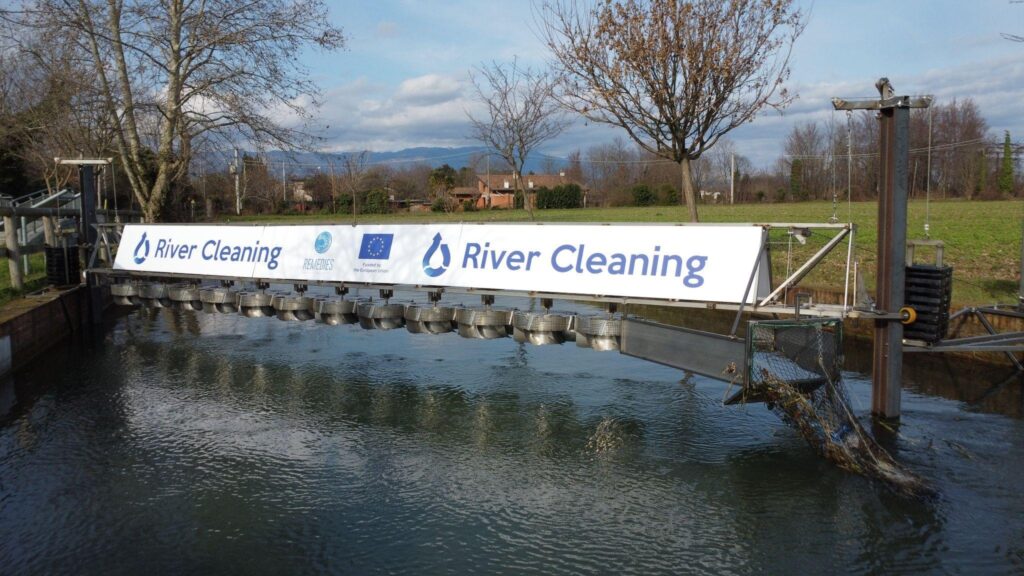
Barrier lifted during protection mode.
The buoy arrays are arranged diagonally. As the buoys rotate, floating litter is captured and gently moved toward a single collection point. The system can be interfaced with an onshore collection infrastructure, such as a conveyor belt or collection cage, so that collected material can be transferred toward waste management and recycling facilities.
For the Lana River in Tirana, a tailor-made version of the barrier was prepared to upgrade the technology and provide a new solution for plastic litter collection in a riverine demo environment. Following the relocation of the implementation site from Albania to Italy, the same system was deployed in Roggia Dolfina (Sant’Anna di Rosà). Even though the system was made to fit the morphology, hydrology and litter composition of Lana River, it was still possible to demonstrate its functioning in the new Italian site.
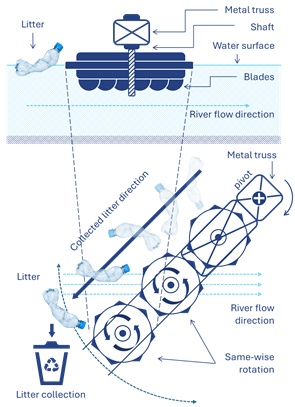
Scheme of the River Cleaning barrier functioning principle
How It Works
- Floating buoys are positioned in a diagonal sequence across the river flow.
- The submerged parts of the buoys are shaped like a passive propeller that uses the water current to rotate the buoying modules.
- The rotating buoys guide floating macro litter toward a single collection point.
- The metal truss can tilt around a hinge, allowing vessel passage and preventing clots or obstructions.
- While the barrier can self-adjust to changes in water level and current intensity, the system is also equipped with lifting array, requiring only one person on the riverbank, for “protection mode” during floods or extreme weather events.
- Collected litter is directed to a collection cage or onshore infrastructure, where it can be removed, weighed, sorted and sent to the nearest recycling or waste management facility.
Technical Features
The River Cleaning barrier combines passive energy use, modularity and low-maintenance operation. The key technical features of the River Cleaning system, as reported in the REMEDIES innovation article include:
- Movable, non-permanent floating buoys powered by submerged propellers.
- An alternative floating “J-shaped” fender to stop litter, developed exclusively for the Albanian Demo Site, as an adaptation to provide better retention performances against wet wipes (detected during seasonal monitoring campaigns).
- A metal truss structure that lifts to enable maintenance, go into protection mode and can host additional equipment or communication material.
- A litter collection cage for waste collection at the shore, directly connected to the main barrier.
- Manual lifting and standby options for extraordinary maintenance or emergency operations, including flood forecasts or rapid water level increases.
- Custom buoying modules for the Lana River, adapted to low water levels and reduced summer flow conditions.
- A non-permanent detachable step downstream from the barrier to help maintain operational water level in dry seasons.
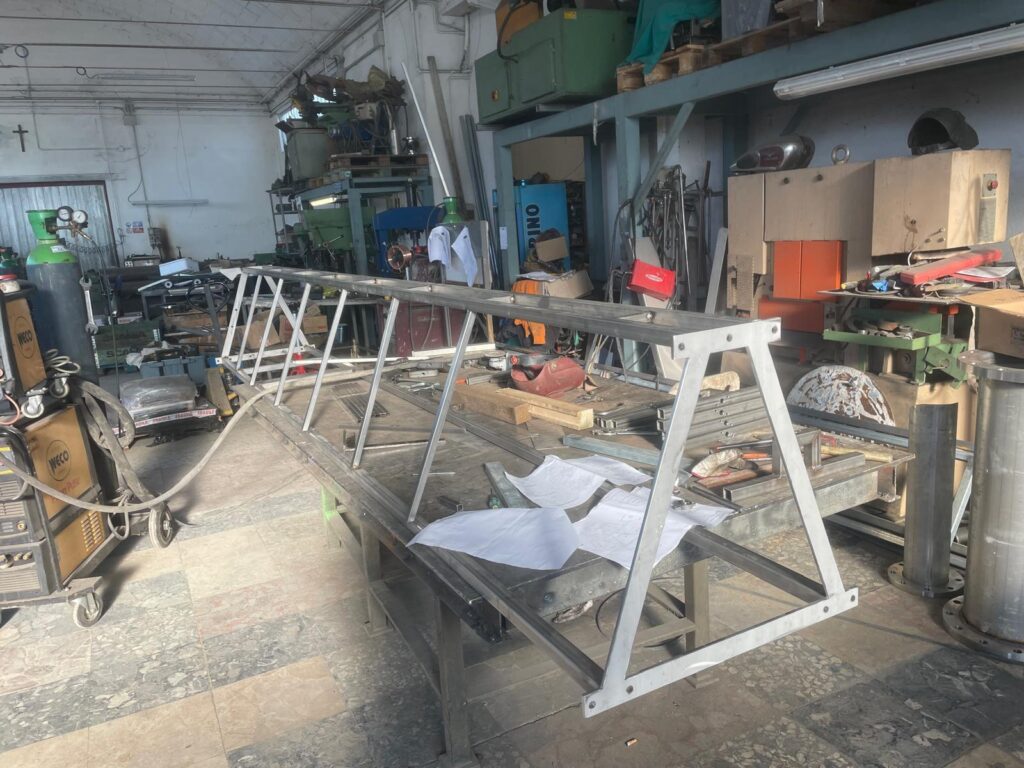
Metal truss being manufactured for the River Cleaning barrier.
-
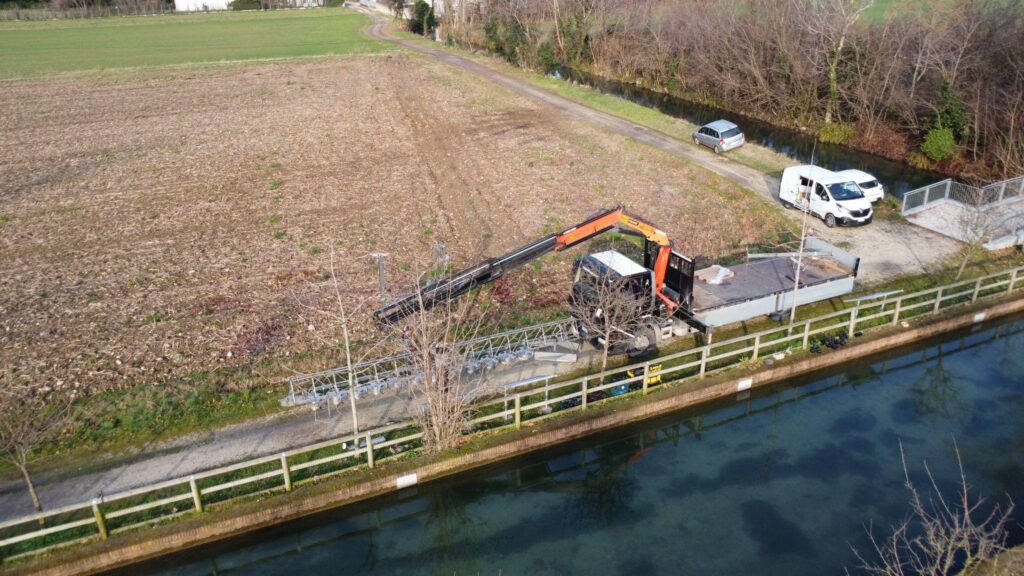
- Deployment of the barrier.
-
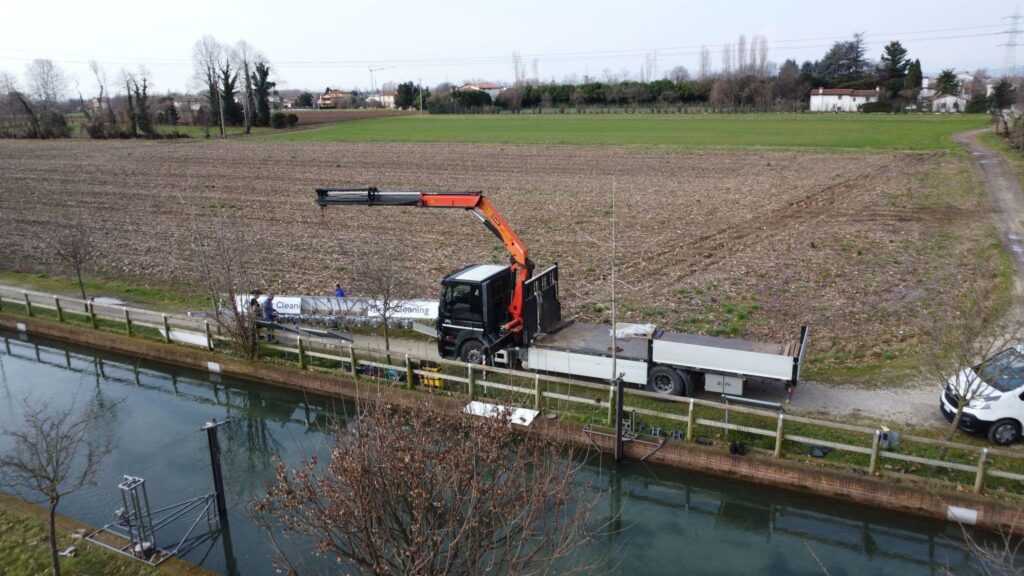
- Anchoring equipment installed, barrier ready for placement.
Unique Value Proposition
- Autonomous Operation: Powered by the natural current, the system operates without external energy and can run passively or on clean energy produced by the system itself.
- Semi-permanent and Adaptable: It does not demand pervasive landscape modification and can be adjusted to different river conditions.
- Minimal Environmental Impact: Unlike conventional booms and nets, the system is designed to allow free movement of aquatic life while capturing waste.
- Operational Efficiency: The system is designed for 24/7 operation with reduced need for human intervention.
- Circular Economy Potential: Controlled litter collection supports sorting, recycling and valorization opportunities, including plastic credits, sponsorships and revenue from collected materials.
- Business Relevance: the use of a River Cleaning barrier within REMEDIES supports the creation of a business-relevant environment for testing, customization, value mapping and replication. This is not changed even after the relocation of the installation site to Italy.
Validation and Demonstration
Before REMEDIES, River Cleaning barriers were evaluated at TRL 6, corresponding to technology demonstrated in the relevant environment. Previous pilots were conducted in Italy, including Campolongo Sul Brenta, the Dolfina Canal and the Martesana Canal in Milan.
- Early field testing showed 80% retention in release and catch experiments with plastic bottles, bottle caps and polystyrene pieces.
- A later Campolongo Sul Brenta test reached 85% retention with improved buoying modules and blade geometry.
- The Dolfina Canal pilot enabled longer-term data collection, including wet and dry weight, material classification and item dimensions, and collected an average of 60 kg of litter per week.
- Independent testing with the University of Palermo showed an average retention result of 97.4%.
- The Martesana Canal pilot in Milan was the first user-paid River Cleaning application and removed an average of 20 kg of litter per day during the test period.
- For REMEDIES, the Lana River in Tirana was chosen as the Albania Demo Site, and the barrier was customized to local hydromorphological conditions.
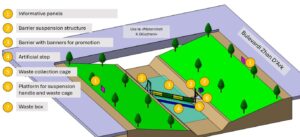
Comprehensive representation of the complete setup for the Lana River deployment.
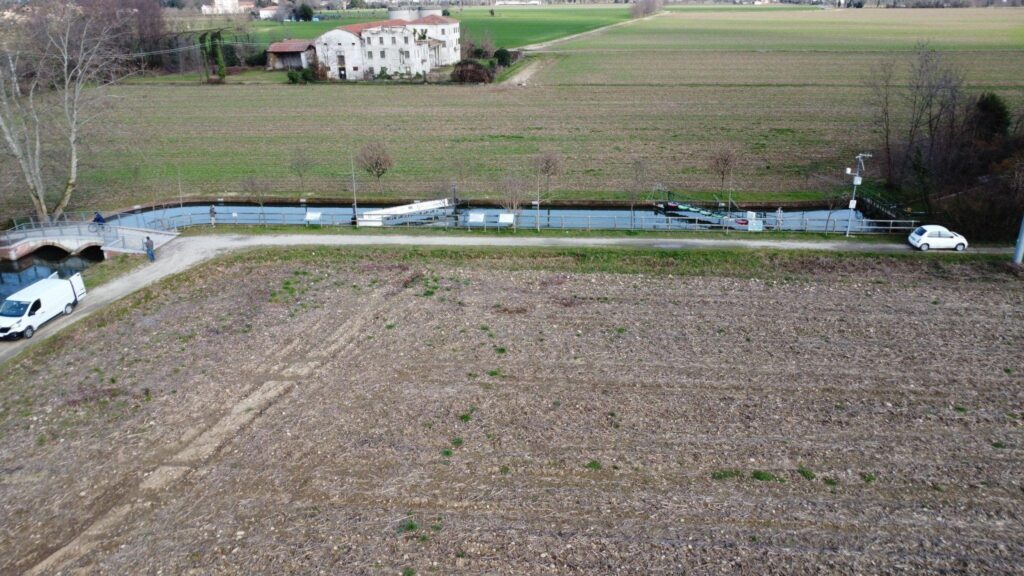
Setup at the replication demo site in Italy, drone view.
Who Can Benefit
- Municipalities that need practical solutions for cleaner rivers and improved local water quality.
- Water management and river basin authorities that need riverine litter interception and monitoring tools.
- Remediation authorities and environmental services companies seeking scalable solutions for river pollution management.
- Marinas and the tourism sector, where cleaner waterways support visitor experience and sustainability commitments.
- Packaging manufacturers and companies aiming to support circular economy initiatives, ESG accountability and valorization of collected waste.
Exploitation Pathway
The commercialization and deployment strategy described in the REMEDIES innovation article includes product leasing, ESG accountability readiness, maintenance and advisory services, and market expansion through distributors and licensing.
- Product Leasing: Offering the system through leasing models to municipalities and industry partners to reduce upfront costs.
- ESG Accountability Readiness: Enabling companies to support River Cleaning installation and generate environmental and social value through a data-based approach.
- Maintenance and Advisory Services: Supporting long-term operational success through technical assistance and optimization recommendations.
- Market Expansion: Working with distributors to license the technology regionally and globally.
In order to capitalise on the technology advancements and installation, RC developed a replication-oriented value mapping framework covering environmental, social and economic value, including pollution reduction, biodiversity observations, community engagement, governance collaboration, operating costs, recycling potential and stakeholder return on investment.
Discover More
Learn more about River Cleaning: https://rivercleaning.com/
Contact: info@remedies.com