
Innovation snapshot
Wasser 3.0 PE-X® is a filter-free microplastic removal technology based on organosilane-induced agglomeration-fixation. In wastewater, the abcr eco Wasser 3.0 PE-X® reagent promotes the clumping of microplastic particles into larger, stable agglomerates through the interaction between organosilane groups and microplastic surfaces, followed by a water-induced sol-gel process that forms a hybrid silica gel structure. The formed agglomerates can then be separated using coarse-pored separation units, avoiding the dependence on fine filtration membranes.
Related REMEDIES pillars: Detection & Monitoring; Collection & Valorisation; Prevention & Zero-Waste Solutions
Partner(s)/Owner(s): Wasser 3.0 gGmbH
Made for: Industrial users, wastewater treatment plants (WWTPs), plant builders, environmental protection bodies, analytical laboratories, public authorities and investors in water innovation
Technology maturity: Advancing from TRL 5 to TRL 8 by the end of the REMEDIES programme
Commercial relevance: Designed for organisations that need a scalable, filterless, low-maintenance solution for detecting, removing and reusing microplastics from wastewater and process water
REMEDIES demo context: Tested at the Mykonos WWTP within the Cyclades Demo Site, with monitoring and optimisation of the process under real wastewater treatment conditions
Demo Site of Cyclades video:
The challenge it addresses
Microplastic pollution in wastewater is difficult to monitor and difficult to remove. Wastewater treatment plants are recognised pathways for microplastics entering aquatic environments, but they can also act as control points for targeted removal. Conventional and advanced treatment systems may reduce microplastic loads, but performance varies, and some technologies mainly transfer particles to sludge or require high maintenance, energy input or fine filtration. This is especially relevant for coastal and island regions where treated water is discharged close to sensitive marine ecosystems.
- Detection and quantification: microplastics are hard to measure with routine, comparable and fast methods, and no fully standardised monitoring method is yet established.
- Efficient removal: microplastics remaining after secondary treatment can still reach rivers, seas and coastal waters.
- Operational stability: WWTPs with seasonal tourism pressure and irregular influent loads need robust post-treatment systems that can stabilise effluent quality.
- Resource recovery: removed microplastic agglomerates need a reuse or recovery pathway so that removal does not simply create another waste stream.
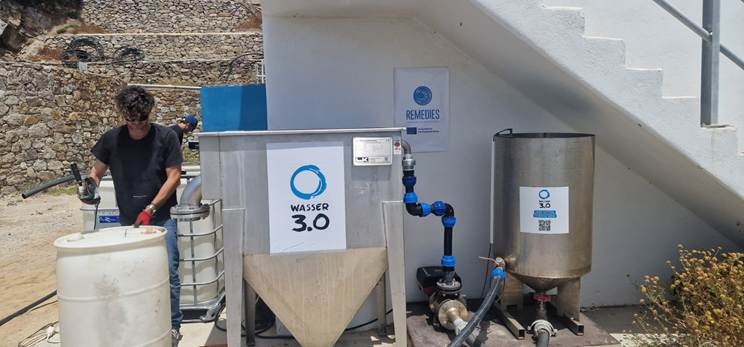 Wasser 3.0 PE-X® microplastic removal pilot installation at the Mykonos WWTP, Cyclades Demo Site.
The solution
Wasser 3.0 PE-X® uses the principle of agglomeration-fixation, also described as Clump & Skim. The reagent is added to process water, where organosilanes interact with microplastic surfaces and trigger agglomeration. The resulting agglomerates grow to sizes that can be removed through a separation unit, without relying on fine-pored membrane filtration. In the Mykonos pilot, the process was tested as an additional post-treatment step after the conventional activated sludge line.
Within REMEDIES, the technology is linked to fluorescence-based microplastic detection for monitoring and validation. In the Cyclades Demo Site, the Mykonos WWTP was used to test Wasser 3.0 PE-X® on the secondary effluent from the conventional activated sludge line, before discharge to the Mediterranean/Aegean marine environment. The scientific validation tested five semi-continuous experimental loops under real effluent conditions.
The approach is designed as an add-on or standalone treatment step. It can be adapted to municipal WWTPs, industrial wastewater, production processes, recycling facilities and other microplastic hotspots, after feasibility testing and process-specific optimisation.
Unique value proposition
- Filterless removal: removes microplastics through Clump & Skim instead of fine filtration membranes.
- Validated performance in Mykonos: the pilot trials reported an average microplastic removal efficiency of 86 ± 8%, reducing influent concentrations from 633-5843 microplastics/L to 96-263 microplastics/L across five experimental loops.
- Effluent quality improvement: in parallel with microplastic removal, the pilot reduced total suspended solids by 95 ± 3%, turbidity by 93 ± 7% and chemical oxygen demand by 70 ± 20%, while pH and conductivity remained stable.
- Filter-free separation: coarse-pored separation of formed agglomerates reduces the operational pressure associated with fine filtration, fouling and clogging.
- Targeted post-treatment: the process removes remaining microplastics after conventional treatment and can help stabilise effluent quality under variable input conditions.
- Circular economy route: formed agglomerates are recyclable and can be considered for construction materials or energy recovery, supporting a recovery pathway for removed material.
- Modular deployment: systems can be operated as batch, semi-continuous or continuous treatment units and integrated into existing wastewater infrastructure.
Technical characteristics
- Technology principle: Agglomeration-Fixation / Clump & Skim.
- Detection and process monitoring: fluorescence-based microplastic analysis was used for validation, including sample filtration, digestion, fluorescent staining and microscopy-based particle counting.
- Treatment model: add-on treatment step, standalone installation, batch, semi-continuous or continuous mode, depending on site requirements.
- Pilot configuration in Mykonos: stainless-steel pilot unit with 0-2 m³ capacity, 0.8 m³ separation unit and 5 m³/h flow rate, installed downstream of the conventional activated sludge line.
- Removal mechanism: organosilane-induced agglomeration-fixation for microplastics, combined in the Mykonos trials with a TSS removal reagent to support simultaneous removal of suspended solids.
- Measured parameters in validation: microplastics, total suspended solids, chemical oxygen demand, turbidity, pH and conductivity.
- Reuse pathway: separated agglomerates can be treated as a resource and considered for reuse or recovery rather than as a conventional waste stream.
Field deployment at the Cyclades Demo Site
The REMEDIES Cyclades Demo Site focuses on islands including Santorini, Mykonos, Andros, Tinos and Dilos. The wider demo addresses beach and sediment plastic accumulation, plastic pathways in the Aegean Sea, zero-waste activities, biodegradable fishing gear, reusable cups and bottles, and point-source microplastic cleaning technologies.
Mykonos is a critical site because the island faces strong tourism pressure, high seasonal water demand and a direct link between wastewater management and the Aegean Sea. The scientific paper identifies Mykonos as a representative island site where wastewater pollution is strongly influenced by tourism. The Mykonos WWTP is designed for 48,000 population equivalents (PE), while the off-season population can fall below 10,000 PE.
The Mykonos WWTP has two main treatment lines: a conventional activated sludge line with a maximum capacity of 8,400 m³/day and a membrane bioreactor line with a maximum capacity of 10,800 m³/day. The scientific removal trials were conducted on the secondary effluent from the conventional activated sludge line. The system operated in semi-continuous mode.
The trials were conducted under real operating conditions. The wastewater delivered to the WWTP showed strong variation in chemical oxygen demand, total suspended solids (TSS) and turbidity because of irregular truck-delivered wastewater volumes. Despite this variability, the pilot consistently reduced both the microplastic and particulate pollution and produced more stable effluent quality.
-
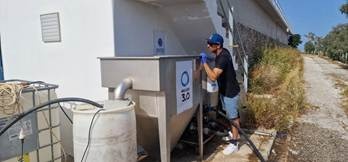
- Field connection and set-up works for the pilot unit at the Mykonos wastewater treatment plant
-
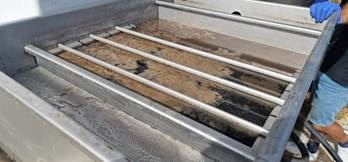
- Separation unit during the removal process, showing retained suspended material and agglomerates
The Cyclades demo gives potential buyers, public authorities and investors a real coastal use case: a modular microplastic removal process that simultaneously reduces the TSS load, tested in a high-pressure island environment where wastewater quality, marine protection and tourism resilience are closely connected.
-
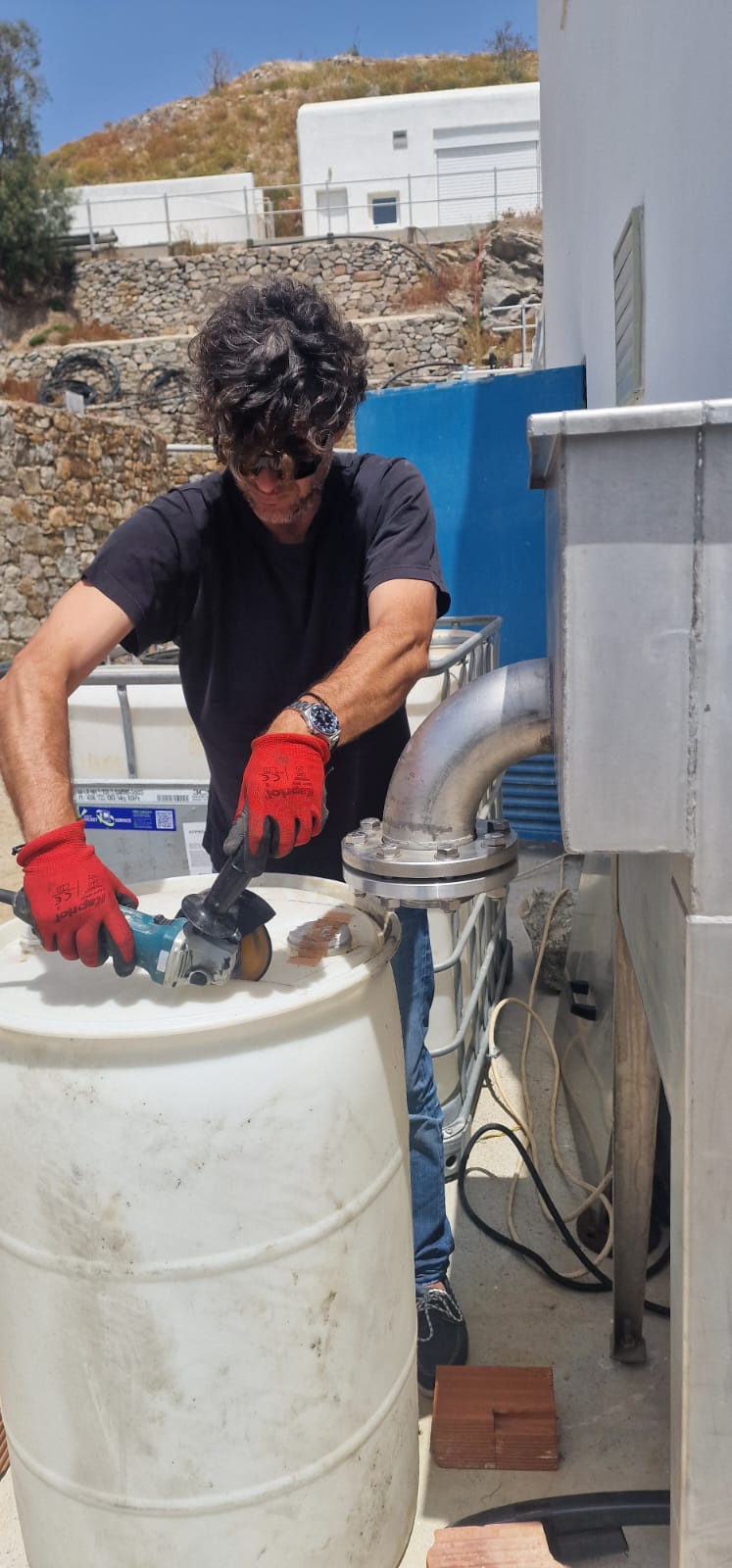
- On-site operation and technical adjustment of the Wasser 3.0 PE-X® pilot system
-
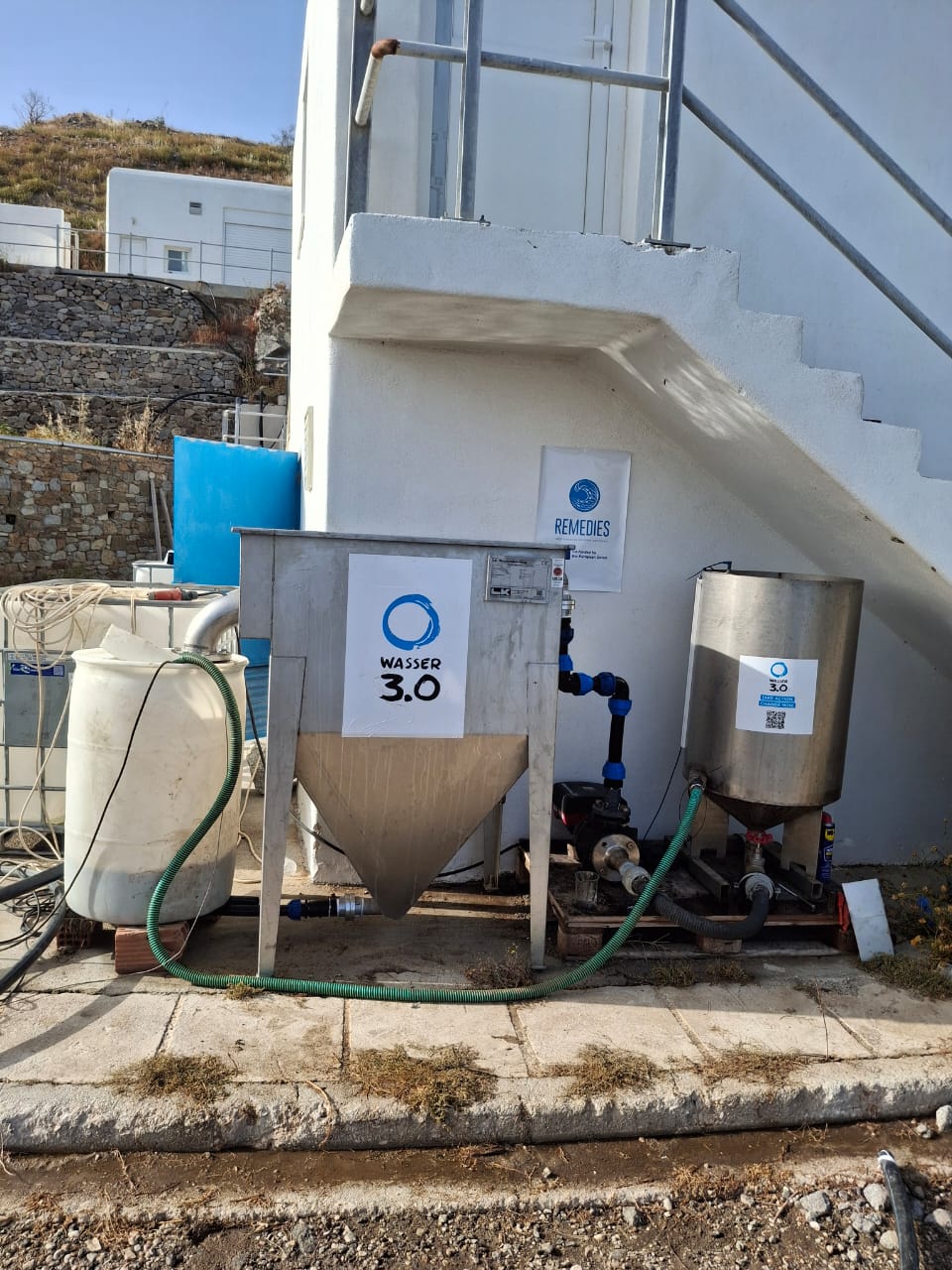
- Full pilot configuration connected to the Mykonos WWTP infrastructure during operation
-
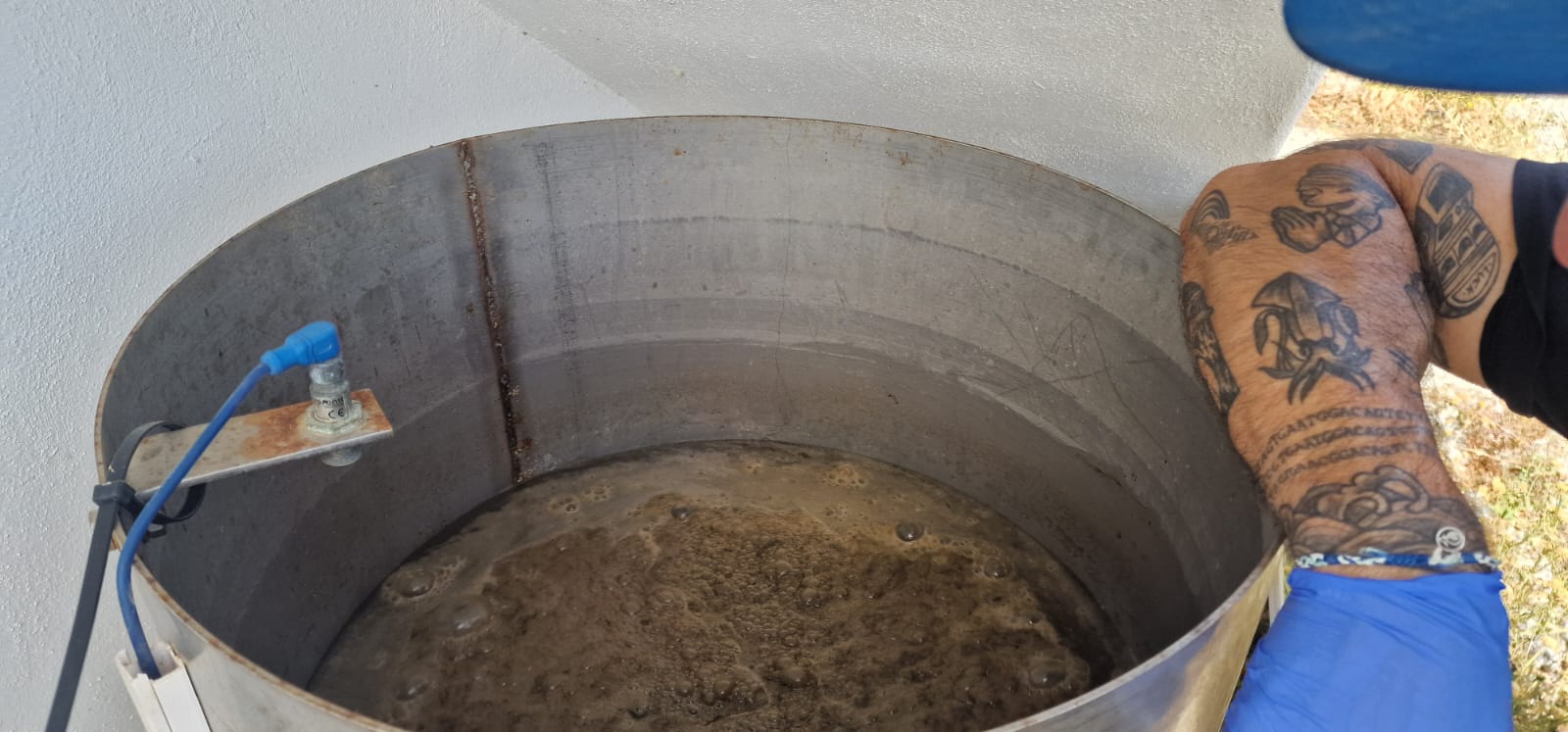
- Reactor view showing agglomerated material formed during the treatment process
Data, monitoring and validation
The Mykonos validation generated scientific data on both microplastic removal and general wastewater quality. Across five experimental loops, influent microplastic concentrations ranged from 633 to 5843 MP/L and effluent concentrations were reduced to 96-263 MP/L, giving an average removal efficiency of 86 ± 8%. The results confirm the robustness of the organosilane-based agglomeration process under real variable effluent conditions.
- Total suspended solids were reduced from 194 ± 173 mg/L to 7 ± 5 mg/L, equal to 95 ± 3% average removal.
- Turbidity was reduced from 100 ± 78 NTU to 2 ± 0.2 NTU, equal to 93 ± 7% average removal.
- Chemical oxygen demand was reduced from 323 ± 254 mg/L to 53 ± 2 mg/L, equal to 70 ± 20% average removal.
- pH and conductivity remained essentially stable, indicating that the process did not create strong ionic changes in the treated effluent.
Who can use it
- Wastewater treatment plants: add a targeted microplastic removal step before discharge.
- Industrial users: prevent microplastics from production, processing or recycling wastewater entering the environment.
- Plant builders and technology integrators: offer a modular add-on for existing treatment infrastructure.
- Public authorities and environmental bodies: deploy a measurable solution for water protection and compliance-oriented pilots.
- Analytical laboratories and research institutions: combine monitoring, validation and process optimisation.
- Funders and investors: support a scalable GreenTech solution with a clear exploitation pathway and direct relevance to marine protection.
Deployment and exploitation pathway
- Feasibility study and process analysis to understand water composition, microplastic load, suspended solids and treatment needs.
- Laboratory and technical-scale trials to determine the most suitable Wasser 3.0 PE-X® reagent configuration, TSS removal support and dosing strategy.
- On-site pilot installation for real effluent testing, including validation of microplastic removal, TSS removal and effluent quality stability.
- Full deployment as an add-on or standalone post-treatment solution, with monitoring, dosing optimisation and integration into WWTP or industrial workflows.
- Circular reuse or recovery pathway for removed agglomerates, supporting resource conservation and reducing secondary waste.
- Replication in other Mediterranean demo sites, WWTPs, industrial water systems and microplastic hotspots, especially where seasonal or irregular loading affects effluent quality.
Discover more and contact
Wasser 3.0: https://wasserdreinull.de/
Contact for further information: info@remedies.com