

The Durrës & Tirana Demo Site in Albania focuses on Detection and Monitoring, Collection and Valorisation, and Prevention and Zero Waste, with particular attention to riverine litter. The Demo Site is connected to Tirana Municipality, Durrës Municipality, the Environmental and Territorial Management Institute, and River Cleaning (RC), addressing the pollution pathways that connect urban areas, rivers, coasts, and the Adriatic Sea. Tirana’s Lana River flows into the Ishëm River, one of the contributors to plastic pollution in the Adriatic, making the site highly relevant for testing river and shore plastic waste collection approaches before litter reaches marine ecosystems. A visual update on the site is available through the video Updates on the Albanian REMEDIES Demo Site: River and shore plastic waste collection.
The Durres & Tirana Demosite, throughout its implementation engaged a various number of stakeholders during the local workshops and awareness raising activities. ETMI has engaged stakeholders in the national conference and local workshops to discuss the plastic pollution initiatives and actions.
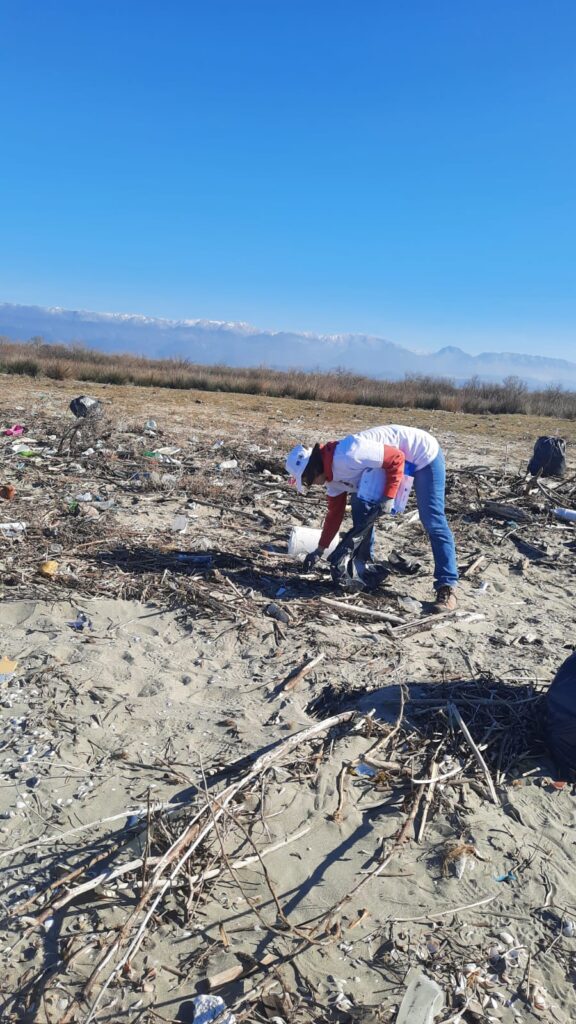
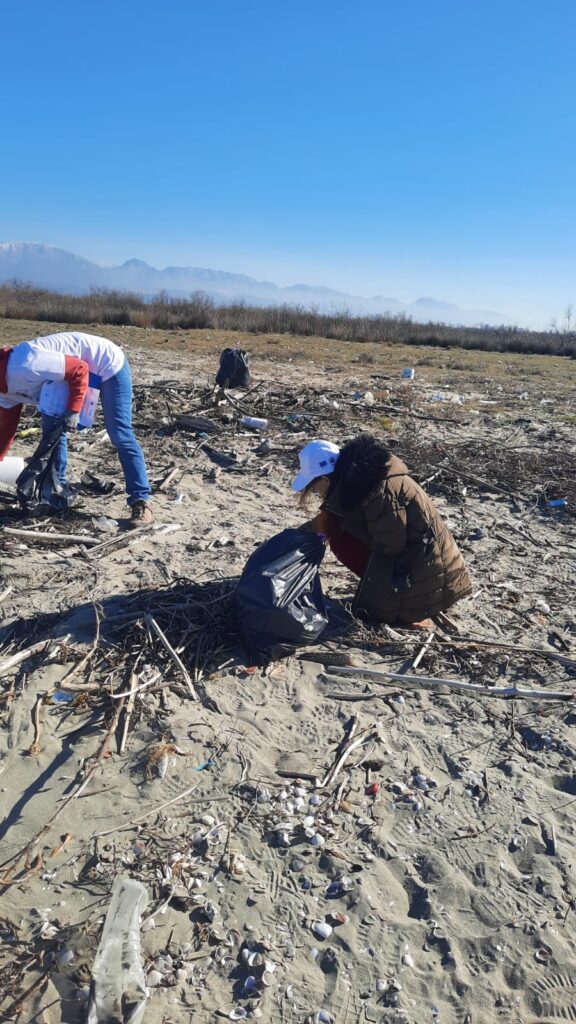
An early step was the beach litter monitoring workshop with local NGOs in Albania, organised by Environmental & Territorial Management Institute (ETMI) on 30 January 2024 to introduce local environmental NGOs to the REMEDIES beach litter monitoring protocol. During the workshop, Meivis Struga from Environmental & Territorial Management Institute (ETMI) presented the marine litter protocol and the main criteria for identifying monitoring hotspots, while Javier Delgado Gallardo from VITO explained the use of the marine litter app for data uploading and monitoring. The following day, on 31 January 2024, around 10 participants from Environmental & Territorial Management Institute (ETMI), VITO, National Institute of Chemistry Slovenia (NIC), and local NGOs carried out beach litter monitoring along the Ishëm River mouth, collecting around 250 kg of waste during the testing activity.
The site visit also supported the preparation of river technology deployment. During the first riverine litter monitoring at River Lana, representatives from Environmental & Territorial Management Institute (ETMI), VITO, and National Institute of Chemistry Slovenia (NIC) assessed potential locations for installing the River Cleaning (RC) technology, discussed possible sites with the municipality, tested the river litter app, and uploaded data to the Floating Litter Monitoring App. This was followed by a second riverine litter monitoring activity at Lana River on 15 March 2024, where the Environmental & Territorial Management Institute (ETMI) team monitored and categorised floating litter for 30 minutes according to the river litter protocol. The predominant litter consisted of wet wipes of different sizes, followed by cigarette butts, and the data were uploaded to the Floating Litter Monitoring App for future comparison before and after the technological intervention in the river basin. (Remedies)
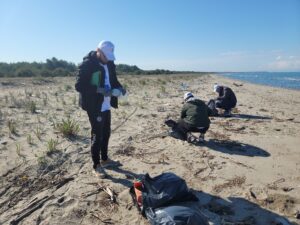
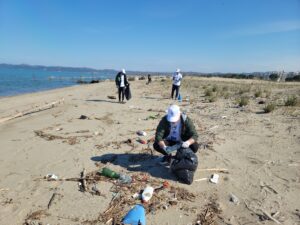
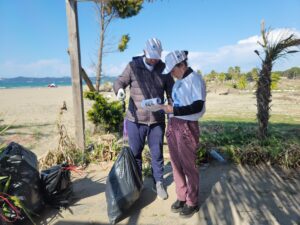
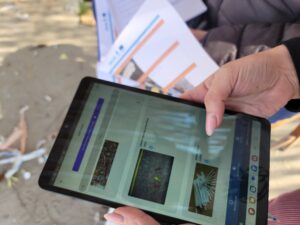
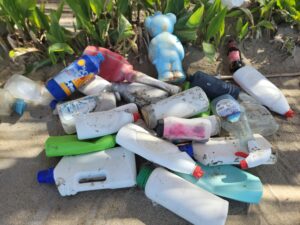
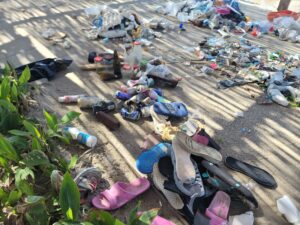
Coastal monitoring also became a key part of the Albanian Demo Site. On 17 March 2024, Environmental & Territorial Management Institute (ETMI) carried out beach litter monitoring at Hamallaj Beach, located along the Adriatic coastal area about 14 km southeast of Durrës. The team monitored a 100-metre beach section according to the beach litter monitoring protocol and collected 51 kg of waste, including 28 kg of plastic waste and 23 kg of other waste. Plastic items included caps, cleaning-product bottles, cosmetic and body-care packaging, non-foamed plastic fragments, and foamed polystyrene, while other waste included cardboard, metal cans, glass bottles, and jars. The collected data were uploaded to the REMEDIES App, with volunteers and local NGOs supporting the monitoring and categorisation process. The field activity is also available through the Hamallaj Beach Litter Monitoring video.
On 23 and 24 April 2024, Tirana hosted the 4th General Assembly of the REMEDIES programme at the Tirana International Hotel & Conference Centre, organised by Environmental & Territorial Management Institute (ETMI) and bringing together all 23 REMEDIES partners. The meeting created space to review project progress, discuss upcoming milestones, and strengthen collaboration across the consortium. Work Package leaders presented current achievements and future goals, while parallel sessions focused on topics such as the underwater drone monitoring approach for Demo Sites and the development of business models and socio-ecological governance with local stakeholders.
The following day, on 25 April 2024, Tirana hosted the 2nd REMEDIES Cluster Meeting, “From Home to Rivers, Seas, and Ocean” at the Tirana International Hotel. Moderated by Meivis Struga from Environmental & Territorial Management Institute (ETMI), the meeting brought together experts, policymakers, and stakeholders to map the journey of plastic pollution from everyday life to rivers, seas, and the ocean. It included welcome speeches from Tirana Municipality, REMEDIES project management, and Environmental & Territorial Management Institute (ETMI), and featured discussions on the EU Mission Ocean, plastic litter flows, marine ecosystem impacts, and the role of key actors such as the INSPIRE project, Marine Conservation Greece (MCG), River Cleaning (RC), and Plastic Pirates GO EUROPE. The related announcement page also framed the meeting as part of REMEDIES’ effort to build a movement by connecting stakeholders under the Mediterranean Lighthouse and linked the session to Albanian actors including the Environmental and Territorial Management Institute, the Agricultural University of Tirana, the Ministry of Tourism and Environment, GIZ, and River Cleaning (RC).
The River Cleaning System is the core REMEDIES innovation developed for the collection of litter in rivers. The system was originally planned for demonstration in the Lana River in Tirana, Albania, and preparatory communication with the Municipality of Tirana was carried out by ETMI together with River Cleaning (RC). Although the administrative process had progressed, the Municipality later raised technical concerns regarding the compatibility of the RC barrier with the Lana River’s hydrological conditions. In particular, concerns were linked to rapid water-level fluctuations, high-flow events, safety risks linked to manual lifting, possible damage from large debris, and the limited ability of the barrier to cover the full river section during medium or high water levels. Based on these issues, the Lana River was considered unsuitable for achieving the expected demonstration objectives. Consequently, the demonstration was relocated to Roggia Dolfina, Italy, where the River Cleaning System could be tested under more appropriate conditions. This system was developed by River Cleaning (RC) with the University of Maribor (UM) involved in sustainability assessment. The system is a semi-permanent river solution for collecting floating plastic litter before it reaches the sea. It uses spinning modules to capture riverine litter while avoiding clogging and water stagnation, which can otherwise deteriorate water quality and accelerate plastic fragmentation into microplastics. The system is autonomous, eco-friendly, requires limited maintenance, and is designed for municipalities, water management and river basin authorities, remediation authorities and environmental services companies.
The river cleaning technology is also presented here:
In 2025, the Demo Site entered a new phase through the REMEDIES Anti-Litter Campaign in Albania, led by Environmental & Territorial Management Institute (ETMI) in collaboration with Milieukontakt Albania. Running from April to September 2025, the campaign focuses on reducing plastic pollution in rivers, educating local communities, and promoting innovative solutions to protect freshwater ecosystems. Its activities include river clean-ups, monitoring actions, educational sessions, technology showcases, and engagement with local and regional authorities, conservation organisations, businesses, researchers, technology providers, policymakers, investors, and local communities.
The campaign was also supported by the 4th PLASTIC FANTASTIC Webinar on Plastic Identification, held on 10 April 2025. Organised as part of the Albanian Demo Site campaign by Environmental & Territorial Management Institute (ETMI) and Milieukontakt Albania, the webinar brought together the University of Maribor (UM), Venice Lagoon Plastic Free (VLPF), Environmental & Territorial Management Institute (ETMI), Impact Hub Athens (IHA), and River Cleaning (RC). It focused on plastic identification, recyclability, monitoring techniques, sustainable waste management, the current state of the Durrës-Tirana Demo Site, and the River Cleaning (RC) System as an energy-free floating barrier that captures plastic waste in rivers before it reaches the ocean. The session was designed for community members, environmental advocates, municipalities, water and river basin authorities, remediation actors, environmental services, marinas, tourism stakeholders, and packaging manufacturers.
The campaign continued with new field activities at Hamallaj Beach. On 16 November 2025, Environmental & Territorial Management Institute (ETMI) and Milieukontakt Albania carried out beach clean-up and litter monitoring activities at Hamallaj Beach in the Ishmi Basin, combining a clean-up with the Autumn 2025 seasonal beach litter monitoring. The action involved representatives from both organisations and young participants from the September Summer School in Durrës, previously trained in J-LIST coding and the beach litter monitoring protocol. The clean-up collected 251 kg of litter, including 157 kg of plastic waste and 94 kg of other waste, while the monitoring exercise categorised 689 items with a total weight of 32.29 kg, including 22.61 kg of plastic. Both datasets were reported through the REMEDIES App. The same article also links the work with the Cleaner Rivers – Cleaner Seas (RiverClean) project and with a World Rivers Day youth engagement activity at the Ishëm River estuary.
Together, the Durrës & Tirana Demo Site updates show how Albania is advancing the REMEDIES mission through a strong river-to-sea approach: identifying monitoring hotspots, testing citizen science tools, preparing river-cleaning technology, gathering field data through REMEDIES apps, engaging NGOs and young people, hosting international project exchanges, and mobilising clean-up actions in both riverine and coastal environments. By connecting the Lana River, the Ishëm basin, Hamallaj Beach, Durrës, and Tirana, the Demo Site demonstrates how local authorities, research partners, technology providers, civil society, and communities can work together to intercept plastic pollution before it reaches the Adriatic and wider Mediterranean waters.